
How to Make Money From LinkedIn: 10 Practical Ways to Earn Online
LinkedIn is no longer just a website for finding jobs and uploading your resume. It has become a powerful platform for freelancers, consultants, creators, business owners, and professionals who want to attract clients and generate income.
If you are wondering how to make money from LinkedIn, you do not need millions of followers. A well-optimized profile, useful content, and a clear offer can help you connect with people who are actually interested in what you do.
The key is to treat LinkedIn as a business and networking platform rather than simply a social media app. In this guide, you will learn practical ways to turn your LinkedIn presence into an income-generating asset.
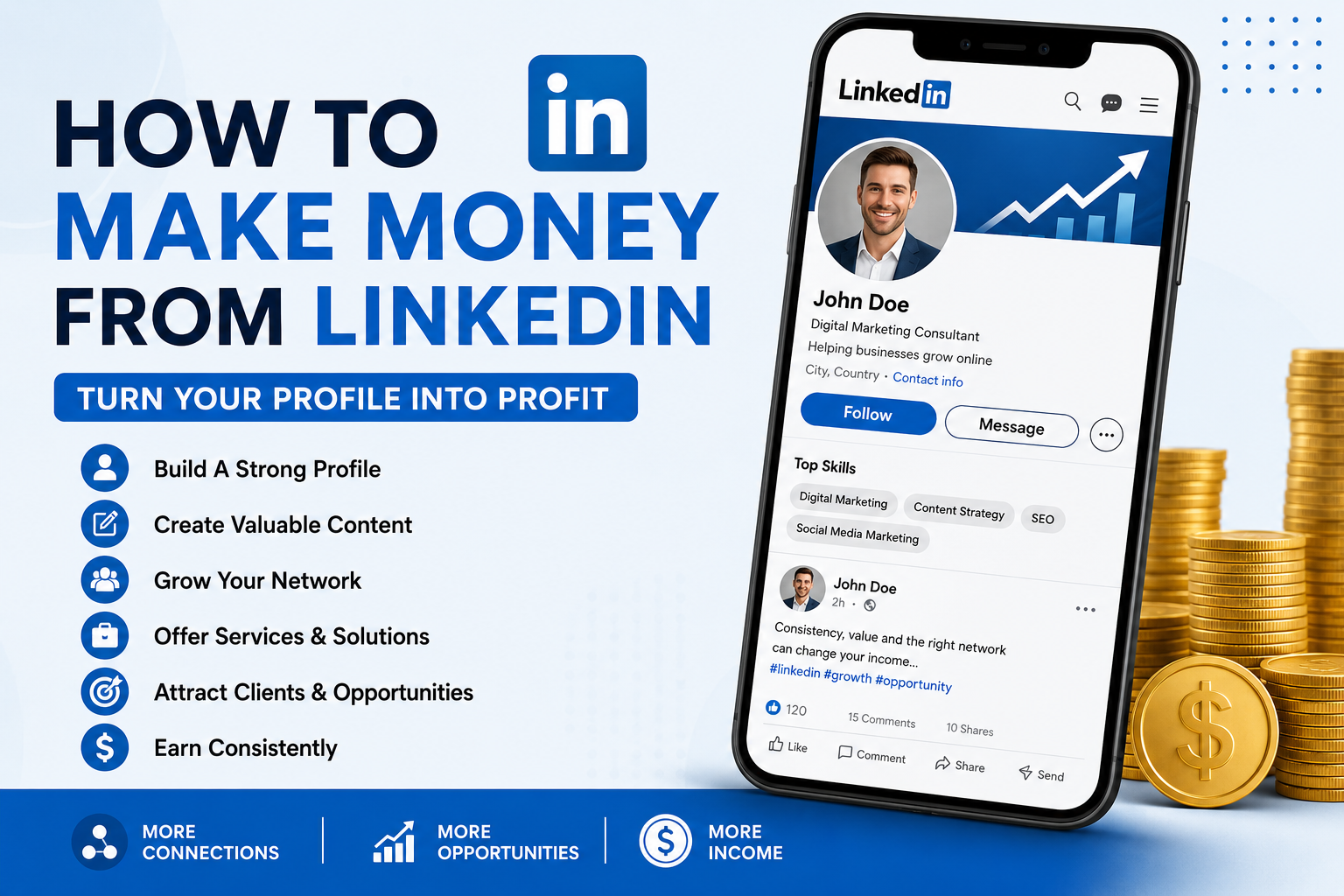
Table of Contents
- Can You Really Make Money From LinkedIn?
- 10 Ways to Make Money From LinkedIn
- 1. Freelancing
- 2. Find Clients for Your Business
- 3. Offer Consulting Services
- 4. Get Remote or High-Paying Jobs
- 5. Sell Digital Products
- 6. Build a Personal Brand
- 7. Affiliate Marketing
- 8. Create Sponsored Content
- 9. Recruit or Refer Candidates
- 10. Generate Leads for Your Agency
- How Many Followers Do You Need?
- Beginner Action Plan
- How Long Does It Take?
- Common Mistakes
- FAQs
- Final Takeaway
Can You Really Make Money From LinkedIn?
Yes. However, LinkedIn usually does not work by simply paying you for every post or follower.
Instead, LinkedIn can help you find customers, clients, employers, business partners, and people interested in your expertise.
For example, a graphic designer can use LinkedIn to find businesses that need branding. A copywriter can attract companies looking for website content. A software developer can demonstrate technical knowledge and attract recruiters or clients.
Think of LinkedIn as a place where you build visibility + trust + professional relationships.
Once people know what you can do, you can turn those relationships into legitimate business opportunities.
10 Ways to Make Money From LinkedIn
1. Freelancing
Freelancing is one of the simplest ways to use LinkedIn to generate income from your skills.
You can offer services such as:
- Graphic design
- Content writing
- Copywriting
- Video editing
- Web development
- SEO
- Social media management
- Virtual assistance
- Translation
- Data analysis
Instead of saying, “I am a freelancer,” make your profile specific.
For example:
“I help small businesses create SEO-friendly blog content that attracts organic traffic.”
That immediately tells potential clients what you do and who you help.
2. Find Clients for Your Business
LinkedIn can be particularly useful for B2B businesses.
If you run a web development agency, marketing agency, accounting firm, recruitment business, or consulting company, you can use LinkedIn to identify potential customers.
Start by defining your ideal customer.
For example:
Industry: E-commerce
Company size: Small to medium businesses
Problem: Poor website conversion
Service: Website optimization
Then search for people involved in those businesses and start building genuine professional relationships.
Avoid sending hundreds of identical promotional messages. A personalized approach is usually much more professional.
You can learn more about LinkedIn’s professional networking features on LinkedIn
3. Offer Consulting Services
If you have substantial knowledge in a particular field, consulting can become a valuable income stream.
Possible areas include:
- Marketing
- Business strategy
- Career development
- Finance education
- Technology
- Sales
- Human resources
- Operations
- Industry-specific expertise
Your LinkedIn content should demonstrate your knowledge.
For example, instead of posting:
“I offer marketing consulting.”
You could publish:
“Three reasons small businesses struggle to convert website visitors into customers.”
Useful content gives potential clients a reason to trust your expertise.
4. Get Remote or High-Paying Jobs
You can also use LinkedIn to improve your career rather than building a business.
Companies and recruiters use LinkedIn to discover candidates for different roles.
To improve your chances:
- Complete your profile.
- Use a professional profile photo.
- Write a clear headline.
- Explain your experience with specific achievements.
- Add relevant skills.
- Request recommendations from professional contacts.
- Apply for suitable positions.
- Network with people in your industry.
Instead of writing only:
“Responsible for sales.”
Write something more specific, such as:
“Managed a sales pipeline and helped increase qualified leads over a 12-month period.”
Specific results make your experience easier to understand.
5. Sell Digital Products
LinkedIn can also help you sell digital products.
Examples include:
- E-books
- Templates
- Notion templates
- Business spreadsheets
- Resume templates
- Online courses
- Checklists
- Industry guides
- Educational resources
For example, a career coach could post LinkedIn tips and eventually offer a professionally designed resume template.
The content attracts attention, while the product provides a way to monetize that attention.
6. Build a Personal Brand
A strong personal brand can create multiple income opportunities.
You can build your reputation around a particular subject and become known for useful insights.
For example:
Marketing professional → Marketing education
Developer → Software development tutorials
Recruiter → Career advice
Designer → Design education
Entrepreneur → Business lessons
You do not need to become famous.
Your goal is to become recognizable to the right people.
Post useful information consistently and share your actual experience, lessons, mistakes, and observations.
7. Affiliate Marketing
Affiliate marketing can also work on LinkedIn when the products or services are genuinely relevant to your professional audience.
For example, a productivity creator might discuss tools they actually use and provide an appropriate affiliate link where permitted.
Possible categories include:
- Business software
- Productivity tools
- Online education
- Professional books
- Website services
- Business tools
Always disclose affiliate relationships clearly and follow the rules of LinkedIn, the affiliate program, and applicable advertising regulations.
Do not fill your LinkedIn profile with random affiliate promotions. Professional audiences usually respond better to genuine recommendations backed by useful information.
8. Create Sponsored Content
Once you have built a strong professional audience, companies may be interested in collaborating with you.
For example, a technology creator with an audience of developers might work with a software company.
A business creator might collaborate with a productivity platform.
Sponsored opportunities can include:
- Sponsored posts
- Product reviews
- Educational content
- Webinars
- Brand campaigns
The quality and relevance of your audience matter more than simply having a large follower number.
Always make sponsored relationships clear to your audience.
9. Recruit or Refer Candidates
If you work in recruitment or have a strong professional network, LinkedIn can help you identify suitable candidates and business opportunities.
Recruitment firms may earn fees for successfully placing candidates with employers.
This is more specialized than freelancing, but it demonstrates another way LinkedIn can generate revenue: professional connections have business value.
Make sure you understand the laws, contracts, and professional requirements that apply to recruitment activities in your location.
10. Generate Leads for Your Agency
If you operate an agency, LinkedIn can become a consistent source of potential leads.
For example, a digital marketing agency could publish content about:
- SEO mistakes
- Google Ads
- Social media marketing
- Website conversion
- Email marketing
Someone who regularly sees useful content may eventually contact the agency for help.
A simple funnel could look like this:
LinkedIn Post → Profile → Website → Inquiry → Sales Call → Client
The goal is not to make every post a sales pitch.
Instead, use content to demonstrate that you understand the customer’s problems.
How Many Followers Do You Need?
How to Make Money From LinkedIn
You do not need 100,000 followers to make money from LinkedIn.
A person with 2,000 highly relevant connections may have more business opportunities than someone with 50,000 followers who have nothing to do with their industry.
Focus on:
- Relevant connections
- Profile views
- Post engagement
- Direct messages
- Website visits
- Leads
- Client inquiries
- Job opportunities
Quality beats quantity.
Beginner Action Plan
If you are starting from zero, follow this simple approach.
Week 1: Optimize Your Profile
Make sure your profile clearly explains:
Who you are + what you do + who you help.
Improve your:
- Profile photo
- Headline
- About section
- Experience
- Skills
- Featured section
Week 2: Start Creating Content
Choose three topics related to your expertise.
For example, a web developer might post about:
- Website mistakes
- Web development tips
- Lessons from real projects
Aim for useful content rather than simply posting motivational quotes.
Week 3: Build Your Network
Connect with people relevant to your industry.
When sending connection requests, personalize them when appropriate.
Do not immediately pitch your service to everyone who accepts.
Week 4: Introduce Your Offer
Once your profile and content clearly communicate your expertise, start making your offer visible.
For example:
“I help small businesses improve their websites. If you’re struggling with low conversions, feel free to message me.”
Keep it simple.
How Long Does It Take to Make Money From LinkedIn?
There is no guaranteed timeline.
Some people may find a client or job opportunity relatively quickly, while others may need several months to build credibility and a useful network.
Your results depend on:
- Your skill level
- Your niche
- Your profile
- Your network
- Content quality
- Consistency
- Market demand
- Your ability to communicate with potential clients
Instead of expecting instant income, think in stages:
Stage 1: Build your profile.
Stage 2: Build your network.
Stage 3: Demonstrate expertise.
Stage 4: Generate conversations.
Stage 5: Convert relevant opportunities into income.
Common Mistakes
Sending Spam Messages
Copy-pasting the same sales pitch to hundreds of people can damage your reputation.
Having a Vague Profile
If your profile says only “Entrepreneur” or “Freelancer,” visitors may not understand what you actually offer.
Be specific.
Posting Without a Strategy
Random posts may generate occasional engagement but make it harder to build a recognizable professional identity.
Focusing Only on Followers
Follower count is not the same as income.
A smaller network can be extremely valuable if it contains your ideal customers or professional contacts.
Selling Too Aggressively
People do not usually join LinkedIn to receive constant sales pitches.
Teach and provide value before asking people to buy.
Copying Viral Posts
You can learn from successful creators, but your own experiences and expertise will make your content more credible.
FAQs
Can beginners make money from LinkedIn?
Yes. Beginners can use LinkedIn to find freelance clients, apply for jobs, sell services, promote digital products, build professional networks, and explore other legitimate opportunities.
How can I make money from LinkedIn without a job?
You can offer freelance services, consulting, digital products, agency services, or appropriate affiliate recommendations. Your LinkedIn profile becomes a way to attract potential customers.
Do I need thousands of followers?
No. A smaller audience can still generate opportunities if it is relevant to your niche and trusts your expertise.
Can I use LinkedIn for freelancing?
Yes. LinkedIn can help freelancers demonstrate their skills, connect with potential clients, build credibility, and find professional opportunities.
What should I post on LinkedIn to make money?
Post content that demonstrates your expertise and solves problems for your target audience. Tutorials, case studies, lessons, industry insights, mistakes, and practical tips can all work well.
Is LinkedIn good for affiliate marketing?
It can be, particularly when affiliate products are genuinely relevant to your professional audience. Always disclose affiliate relationships and follow applicable platform and advertising rules.
How often should I post on LinkedIn?
There is no universal number that guarantees success. Choose a sustainable schedule that allows you to consistently publish useful content without sacrificing quality.
Final Takeaway
Learning how to make money from LinkedIn is really about learning how to turn professional visibility into opportunities.
You can use LinkedIn to find freelance clients, attract customers, sell services, promote digital products, find jobs, build a personal brand, or create professional partnerships.
You do not need a huge following to begin.
Start by making your profile clear, choose one area of expertise, publish useful content, build genuine connections, and gradually introduce a product or service that solves a real problem.
The most valuable LinkedIn strategy is not simply getting more views. It is becoming known by the right people for something useful.
When your skills, content, network, and offer work together, LinkedIn can become much more than an online resume—it can become a genuine source of professional income.