
Affiliate Marketing: 7 Proven Tips to Avoid Costly Mistakes
Have you ever recommended a product to a friend and wished you could earn from that recommendation?
That is the basic idea behind affiliate marketing.
You promote a product or service using a special affiliate link. When someone makes a purchase through your link, you can earn a commission.
Sounds simple, right?
However, building a profitable affiliate business takes more than posting links. You need the right niche, useful content, trusted products, and a clear strategy.
In this guide, you will learn how affiliate marketing works and how beginners can get started. You will also discover seven practical tips that can help you avoid common mistakes.
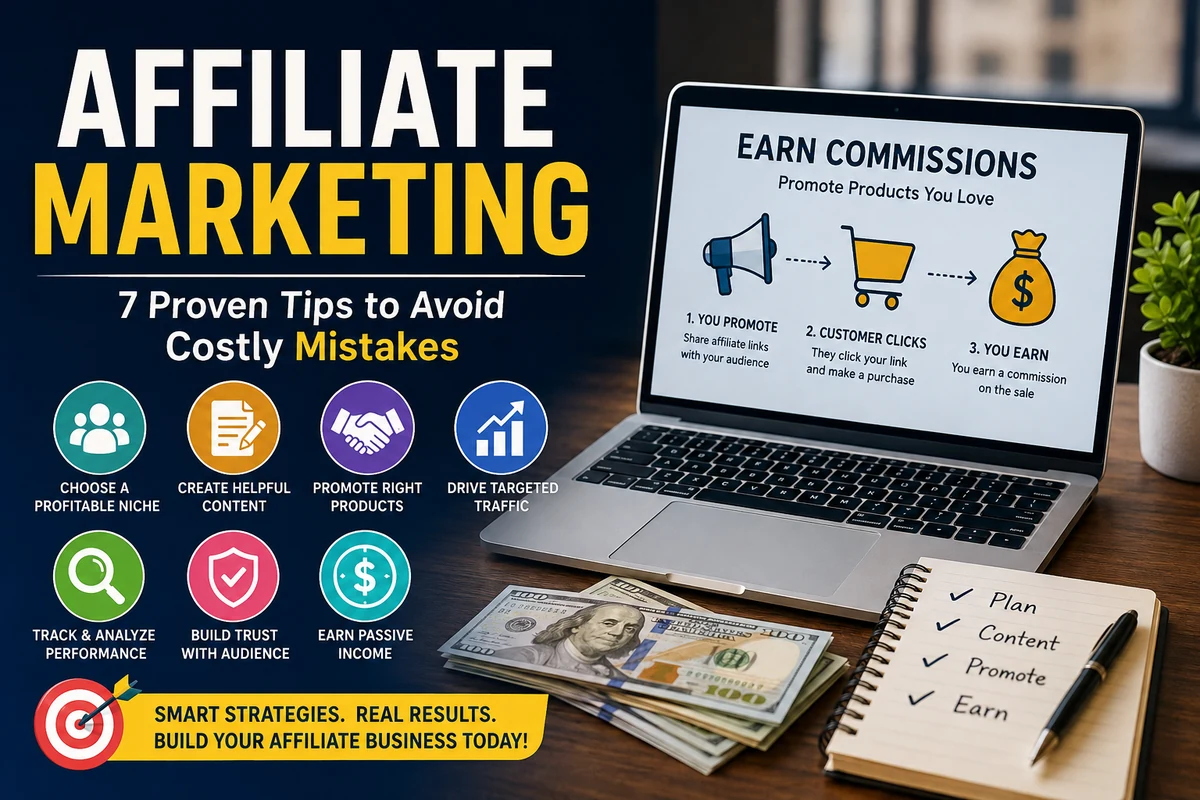
Table of Contents
- What Is Affiliate Marketing?
- How Does Affiliate Marketing Work?
- How to Start Affiliate Marketing
- 7 Proven Tips for Better Results
- Common Beginner Mistakes
- How to Grow Your Affiliate Income
- Frequently Asked Questions
What Is Affiliate Marketing?
Affiliate marketing is a performance-based business model.
You promote another company’s product or service. Then, you earn a commission when your referral leads to a qualifying action.
That action is often a sale. However, some programs may pay for leads, app installs, or other actions.
For example, imagine you run a website about home office products.
You publish an article about the best office chairs for remote workers. Within the article, you include affiliate links to recommended chairs.
A reader clicks your link and buys a chair.
The merchant tracks that purchase and credits the commission to your affiliate account.
That is affiliate marketing in its simplest form.
How Does Affiliate Marketing Work?
The process usually involves four main players:
- Merchant: The company selling the product or service.
- Affiliate: The person promoting the product.
- Customer: The person who makes the purchase.
- Affiliate Network: A platform that may manage tracking, payments, and affiliate relationships.
First, you join an affiliate program.
Next, you receive a unique tracking link.
You then place that link in your content. This could be a blog post, YouTube video, email, or social media content.
When someone clicks the link, tracking technology records the referral.
If the visitor completes a qualifying action, you may receive a commission.
The commission depends on the program, product, and terms.
How to Start Affiliate Marketing
Starting does not require a huge budget.
However, you should build the right foundation before worrying about commissions.
1. Choose a Specific Niche
Start with a niche you can create useful content about consistently.
Popular areas include:
- Technology
- Personal finance
- Fitness
- Beauty
- Travel
- Education
- Software
- Home improvement
- Pet products
- Online business
Avoid trying to target everyone.
For example, “technology” is extremely broad.
“Best laptops for college students” is much more specific.
A focused niche makes it easier to understand your audience and create relevant content.
2. Understand Your Audience
Before promoting anything, understand what your audience actually needs.
What problems are they trying to solve?
What products are they comparing?
What questions do they search on Google?
For example, someone searching for “best running shoes” may be researching products.
Someone searching for “best running shoes for flat feet” has a much more specific need.
That difference matters.
The more clearly you understand your audience, the easier it becomes to create helpful content.
3. Find Relevant Affiliate Programs
Once you choose your niche, look for reputable affiliate programs.
Do not choose a program based only on commission rates.
Instead, consider:
- Product quality
- Brand reputation
- Commission structure
- Cookie duration
- Payment methods
- Minimum payout
- Program rules
- Customer support
A 30% commission does not help much if nobody wants the product.
In my view, product quality should always come before commission percentage.
4. Create Helpful Content
Now comes the part that can make or break your business.
Create content that helps people make better decisions.
You can publish:
- Product reviews
- Product comparisons
- Buying guides
- Tutorials
- “Best products” lists
- How-to articles
- Case studies
- YouTube videos
- Short-form videos
Do not make every article sound like a sales pitch.
Instead, answer the reader’s question first.
Then recommend products that genuinely fit their needs.
Internal Link Suggestion: Add an internal link here to your related article about SEO Content Writing for Beginners.
7 Proven Tips for Better Results
1. Target a Clear Audience
Trying to reach everyone usually makes your content less useful.
Instead, choose a specific audience.
You could target college students, parents, freelancers, gamers, homeowners, or small business owners.
Then create content around their specific problems.
For example, a website targeting remote workers could cover home office equipment, productivity software, webcams, microphones, and office chairs.
That creates a natural connection between the audience and the products you promote.
2. Recommend Products Honestly
Never recommend a product simply because it offers a high commission.
Your audience can usually tell when content feels forced.
If a product has weaknesses, mention them.
For example, you could explain that a laptop has excellent battery life but limited storage.
That honest approach can make your recommendation more credible.
Over time, trust can become one of your biggest assets.
3. Focus on Commercial Search Intent
Not every keyword has the same value.
Someone searching for “what is a smartwatch” is probably looking for information.
Someone searching for “best smartwatch under $200” may be closer to making a purchase.
Therefore, create a mix of informational and commercial content.
Good commercial topics can include:
- Best products for beginners
- Product A vs. Product B
- Best affordable options
- Best products for specific needs
- Product alternatives
- Product reviews
This strategy can help you attract visitors who are already researching a purchase.
4. Use SEO to Build Long-Term Traffic
Search engine optimization can help your content reach people without paying for every visitor.
Start with keyword research.
Then create useful content around those keywords.
Use clear headings and short paragraphs.
Add descriptive image ALT text.
Link to relevant pages on your website.
Most importantly, write for people first.
Search engines are getting better at understanding useful content. Thin articles created only to insert keywords are unlikely to build a strong website.
Internal Link Suggestion: Add an internal link here to your related article about Keyword Research for Beginners.
5. Use Social Media to Expand Your Reach
Your website does not have to be your only traffic source.
Social platforms can help you reach new audiences.
For example, you could turn a detailed product comparison into a short video.
A 1,500-word article might become several short videos.
You could also create:
- Instagram Reels
- TikTok videos
- YouTube Shorts
- Pinterest content
- Facebook posts
- YouTube reviews
The key is consistency.
Do not simply copy the same content everywhere. Adapt it to each platform.
6. Track Your Performance
You cannot improve what you do not measure.
Track basic metrics such as:
- Website visitors
- Affiliate link clicks
- Conversion rate
- Sales
- Earnings
- Top-performing pages
- Traffic sources
For example, suppose one article receives 5,000 visitors but produces almost no clicks.
That page may need better product recommendations or stronger calls to action.
Another article may receive only 1,000 visitors but generate several sales.
That topic could deserve more attention.
Use your data to guide your next move.
7. Build Trust With Your Readers
Trust matters more than a clever sales pitch.
Tell readers when you may earn a commission from a purchase.
Your disclosure should be easy to find and understand.
The Federal Trade Commission provides guidance about endorsements and affiliate relationships for U.S. audiences. FTC Endorsement Guides
Also, avoid making claims you cannot support.
If you have not personally tested a product, do not pretend that you have.
Honesty may mean losing a sale today.
But it can help you build a website people trust tomorrow.
Common Affiliate Marketing Mistakes
Many beginners make the same mistakes.
Fortunately, most are easy to avoid.
Choosing Products Only for High Commissions
A high commission can look attractive.
However, demand matters more.
If your audience does not want the product, the commission rate will not save the campaign.
Promoting Too Many Products
You do not need hundreds of affiliate links.
A few relevant products can be enough.
Focus on products that solve the problem your reader came to solve.
Publishing Fake Reviews
Never create a fake personal experience.
If you did not use a product, say so.
You can still research it and provide useful information.
Just be transparent about your experience.
Creating Thin Content
An article filled with affiliate links is not useful by itself.
Readers need context.
Explain the product, discuss its benefits, mention its limitations, and help people decide whether it fits their needs.
Expecting Instant Income
Affiliate marketing is not guaranteed quick money.
Some websites may generate commissions quickly.
Others take months to build meaningful traffic.
Results depend on your niche, content quality, traffic, audience, and conversion rate.
Therefore, focus on building an asset instead of chasing overnight income.
How to Grow Your Affiliate Income
Once your website starts receiving traffic, look for patterns.
Which articles get the most visitors?
Which pages generate the most clicks?
Which products convert?
Which topics attract visitors who are ready to buy?
Use those answers to improve your strategy.
For example, suppose an article about budget headphones consistently brings traffic and sales.
You could create related articles such as:
- Best headphones for students
- Best wireless headphones under $100
- Budget headphones comparison
- Best headphones for working from home
- Headphone buying guide for beginners
These related articles can create a strong content cluster.
You can then connect them with internal links.
This approach helps readers discover more useful content while also giving search engines a clearer understanding of your website.
Frequently Asked Questions
Can Beginners Make Money With Affiliate Marketing?
Yes, beginners can earn affiliate commissions.
However, there is no guaranteed income.
Success usually depends on your niche, audience, content quality, traffic, and conversion rate.
Is Affiliate Marketing Free to Start?
It can be started with very little money.
You can create content through platforms such as YouTube or social media without building a website first.
However, a website can become a valuable long-term asset for search traffic.
How Much Can You Make With Affiliate Marketing?
There is no fixed income limit.
Some people earn small amounts, while established affiliate businesses can generate significant revenue.
Your results depend on traffic, commission rates, conversion rates, and product demand.
Do I Need a Website for Affiliate Marketing?
No.
You can use platforms such as YouTube, social media, email, and other channels that allow affiliate promotions.
However, owning a website gives you more control over your content and SEO strategy.
Do I Need to Disclose Affiliate Links?
For U.S. audiences, affiliate relationships should be disclosed clearly when applicable.
The FTC provides guidance on how endorsements and material connections should be disclosed. FTC Advertising and Marketing Guidance
Final Thoughts
Affiliate marketing is not a magic shortcut to easy money.
However, it can become a powerful online business model when you approach it the right way.
Start with one focused niche.
Understand your audience.
Create genuinely useful content.
Recommend relevant products honestly.
Then track your results and improve what works.
You do not need hundreds of articles to get started.
You need your first useful article.
So choose one problem your audience has, create a helpful solution, and publish it.
Your affiliate business can grow one useful piece of content at a time.