
How to Make Money From Print on Demand: A Beginner’s Guide
Have you ever wanted to sell T-shirts, mugs, hoodies, or other products online without buying a large amount of inventory first?
That is exactly what makes print on demand interesting.
With a print-on-demand business, you create a design, add it to a product, and list that product for customers. When someone places an order, the product is printed and shipped by a third-party provider.
You do not have to keep boxes of products at home or handle every order yourself.
But there is one important thing to understand: print on demand is not a guaranteed way to make easy money. Your results depend on your designs, niche, product quality, marketing, pricing, and ability to understand what customers actually want.
So, how do you turn print on demand into a real online business?
Let’s look at the process step by step.
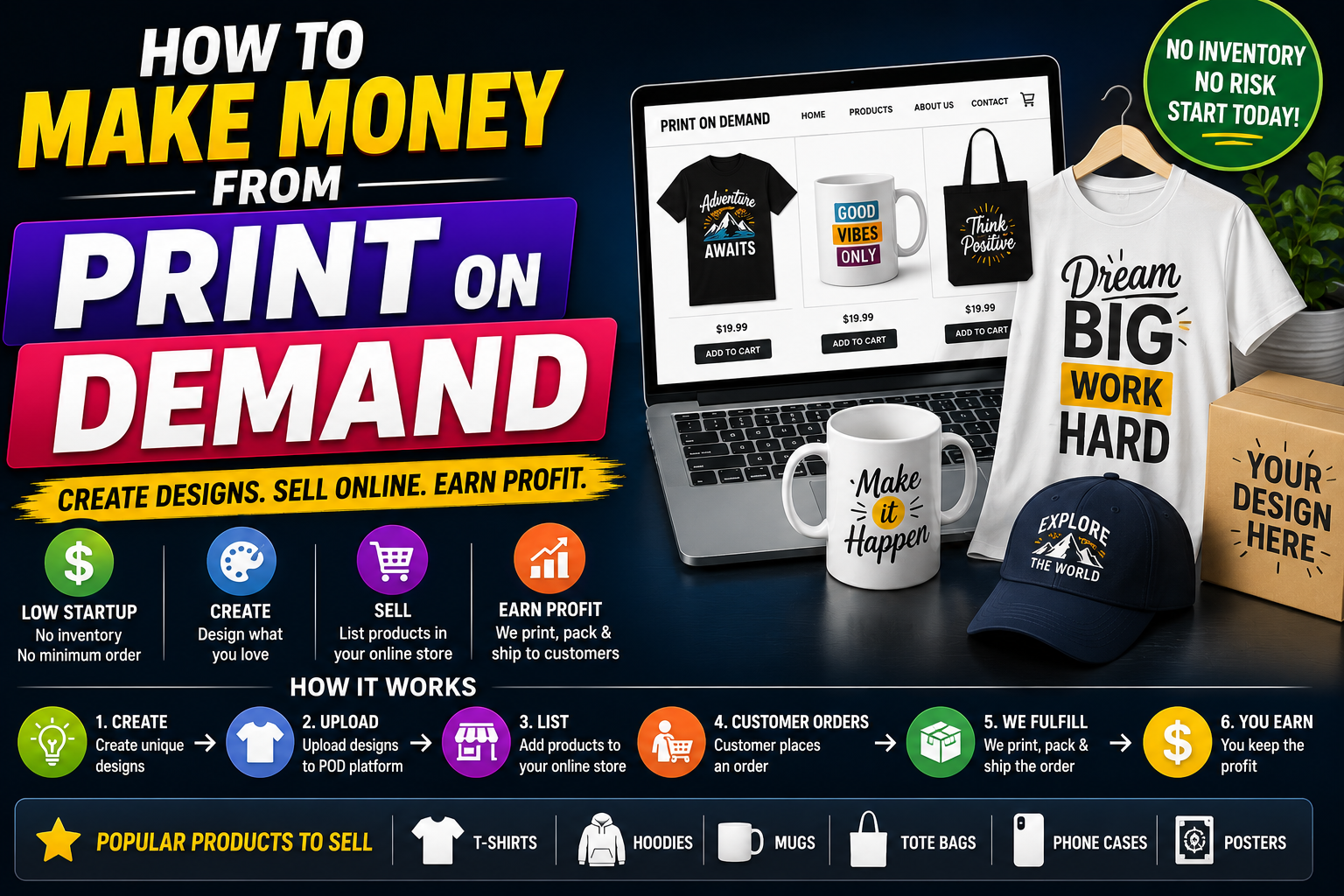
What Is Print on Demand?
Print on demand is an ecommerce business model where products are created only after a customer places an order.
For example, imagine you create a funny design for coffee lovers.
You can place that design on a T-shirt, mug, hoodie, or tote bag and list the products online.
When a customer buys one, your print-on-demand partner produces the item and ships it to the customer.
You earn the difference between the selling price and your costs.
This means you can start without purchasing hundreds of products in advance.
How Does Print on Demand Work?
The basic process is fairly simple:
Choose a niche → Create a design → Select products → Create listings → Market your products → Customer places an order → Product is printed and shipped → You receive your profit
Your job is mainly focused on finding good ideas, creating attractive designs, building listings, and bringing customers to your store.
The printing and fulfillment company handles the physical production and shipping.
That makes print on demand particularly attractive to people who want to start an ecommerce business with less inventory risk.
7 Ways to Make Money From Print on Demand
1. Sell T-Shirts
T-shirts are one of the most recognizable print-on-demand products.
You can create designs around specific interests, hobbies, professions, communities, or humor.
For example, instead of creating a generic “Funny T-Shirt,” you could target a specific audience such as:
- Dog lovers
- Gamers
- Teachers
- Fitness enthusiasts
- Travelers
- Programmers
- Coffee lovers
- Book readers
The more specific your audience is, the easier it can be to create designs that speak directly to them.
A simple design that makes someone say, “That’s me,” can be more effective than a complicated design trying to appeal to everyone.
2. Create Hoodies and Sweatshirts
Hoodies and sweatshirts can give you another product category to sell to the same audience.
A design that works on a T-shirt may also work well on a hoodie.
You can experiment with different placements, typography, and design styles.
However, do not assume that every design will work equally well on every product.
Think about how the design looks on the actual item before publishing it.
Product mockups can help you understand how customers will see the final product.
3. Sell Mugs and Home Products
Print on demand is not limited to clothing.
Depending on the platform and supplier you use, you may be able to sell products such as mugs, posters, wall art, phone cases, tote bags, notebooks, and other personalized items.
This gives you an opportunity to expand your store without completely changing your niche.
For example, a book-lover design could be offered on a shirt, mug, tote bag, and poster.
Instead of creating four completely different ideas, you can build a small product collection around one strong concept.
4. Create Products for Specific Niches
One of the biggest opportunities in print on demand is niche targeting.
A broad design such as “I Love Music” has to compete with countless other products.
A design specifically created for a particular group may have a clearer audience.
You could explore niches based on:
- Hobbies
- Occupations
- Sports interests
- Animals
- Travel
- Food
- Family
- Outdoor activities
- Personal interests
- Lifestyle communities
Before creating designs, research the niche carefully.
Look at what people are buying, what designs already exist, and what customers are saying in reviews.
Your goal is not to copy successful designs.
Instead, use your research to understand the audience and create something original.
5. Use Personalized Products
Personalization can make a product feel more special.
For example, you could create products where customers can add a name, date, location, or other appropriate customization.
Personalized products can work particularly well for gifts and special occasions.
Examples might include:
- Birthday gifts
- Wedding gifts
- Family products
- Pet-themed gifts
- Graduation products
- Anniversary items
The important part is making the customization process simple for the customer.
If buyers cannot easily understand what they are getting, they may leave the listing without purchasing.
6. Build Collections Instead of Selling Random Designs
A common mistake beginners make is uploading hundreds of unrelated designs.
Instead, consider building collections.
For example, you could create a “Coffee Lover Collection” with:
- T-shirts
- Hoodies
- Mugs
- Tote bags
- Posters
Another collection could focus on a particular hobby or profession.
Collections make your store feel more organized and can help customers discover related products.
They also make it easier for you to develop a recognizable style.
7. Build a Brand Around Your Designs
Instead of treating print on demand as a collection of random products, you can build a brand around a specific audience.
Think about the personality of your brand.
Is it funny?
Minimalist?
Motivational?
Premium?
Creative?
Your logo, colors, product photography, descriptions, and designs can all support the same identity.
A recognizable brand can make your store feel more trustworthy than a shop filled with unrelated designs.
How to Choose a Profitable Print-on-Demand Niche
Choosing the right niche is one of the most important decisions you will make.
You want a niche that has enough potential customers but is also specific enough for you to create relevant products.
Start by asking:
- Who is the target customer?
- What interests them?
- What problems or emotions can my designs address?
- Are people already buying products in this niche?
- How competitive is the market?
- Can I create many original designs for this audience?
Do not choose a niche simply because someone says it is profitable.
You also need to understand the audience.
If you know what your customers like, dislike, joke about, celebrate, and identify with, you have a much better foundation for creating products.
How to Create Designs That People Want to Buy
You do not necessarily need to be a professional artist to start.
What matters is creating designs that look good and connect with your target audience.
You can use graphic design software or appropriate AI-assisted tools to help with brainstorming and design creation.
However, always review the final design carefully.
Pay attention to:
- Spelling
- Typography
- Image quality
- Product placement
- Readability
- Originality
- Overall appearance
A design may look great on your computer but poor when printed on an actual product.
That is why checking product previews is important.
Keep Your Designs Simple
Simple designs can be surprisingly effective.
A clear phrase with good typography can sometimes work better than an image filled with too many elements.
Think about what the customer will see from a distance.
Can they understand the design quickly?
Does it communicate an emotion or idea?
Would they actually want to wear or use it?
These questions can help you improve your designs.
How to Price Print-on-Demand Products
Pricing requires more than simply choosing a random number.
You need to consider your product cost, platform fees, transaction fees, marketing expenses, taxes where applicable, and your desired profit.
For example, if a product costs you $12 to produce and fulfill, selling it for $13 may leave very little room for other expenses.
At the same time, setting an extremely high price without offering enough value can make it difficult to compete.
Research similar products in your niche and understand the market before deciding on your price.
Your goal should be to find a price that makes sense for both the customer and your business.
How to Get Customers for Your Print-on-Demand Store
Creating products is only half the job.
You also need people to discover them.
There are several ways you can market your print-on-demand products.
Social Media
Platforms such as Instagram, TikTok, Pinterest, Facebook, and YouTube can help you showcase your designs.
Instead of constantly posting “Buy this,” create content around your niche.
For example, if your store sells products for travelers, you could post travel tips, funny travel content, destination ideas, and behind-the-scenes design content.
Then naturally introduce your products.
Search Traffic
If you sell through an ecommerce marketplace or your own website, search optimization can help people discover your products.
Use clear product titles and descriptions that accurately describe what you are selling.
Think about the words a potential customer would actually type when searching for your product.
Paid Advertising
Advertising can help you reach potential customers faster, but it also introduces financial risk.
Do not spend a large amount of money before understanding which products and audiences are working.
Start carefully, track the results, and increase spending only when the numbers make sense.
Common Print-on-Demand Mistakes
Uploading Random Designs
More products do not automatically mean more sales.
Focus on quality and relevance instead of uploading hundreds of random designs.
Copying Other Sellers
Seeing a successful design does not mean you should recreate it.
Create your own concepts and avoid using copyrighted or trademarked material without permission.
Ignoring Product Quality
A great-looking digital mockup does not guarantee a great physical product.
Order samples when appropriate and understand the quality of the products you are selling.
Forgetting About Profit Margins
A sale is not the same as profit.
Always calculate your actual costs before deciding whether a product is worth selling.
Expecting Immediate Sales
Some products may sell quickly.
Others may take time.
You may need to test different niches, designs, products, prices, and marketing strategies before discovering what works.
Beginner Action Plan
If you are completely new to print on demand, you do not need to create 500 products on your first day.
Start with a simple plan.
Step 1: Choose One Niche
Pick an audience you understand or are willing to research deeply.
Step 2: Research the Market
Study existing products, customer reviews, trends, and competitors.
Look for opportunities rather than copying what already exists.
Step 3: Create Your First Designs
Start with a small collection of original designs.
Focus on quality rather than quantity.
Step 4: Choose Your Products
Select products that make sense for your audience.
Do not put every design on every possible product.
Step 5: Create Professional Listings
Use clear titles, descriptions, mockups, and relevant product information.
Step 6: Start Marketing
Use social media, search traffic, or carefully planned advertising to bring visitors to your products.
Step 7: Track the Results
Look at which designs receive attention and which products generate sales.
Then use that information to create better products.
How Long Does It Take to Make Money From Print on Demand?
There is no guaranteed timeline.
Some sellers may make their first sale quickly, while others may spend months testing products and building an audience.
Your results can depend on your niche, designs, product quality, pricing, competition, marketing, and consistency.
Do not judge your entire business based on the first few days.
Instead, treat your early period as a testing phase.
Learn what people respond to and improve your products accordingly.
FAQs
Is print on demand profitable?
Print on demand can be profitable, but there are no guaranteed earnings. Your profit depends on factors such as product costs, pricing, sales volume, fees, marketing, and demand.
Can I start print on demand with no inventory?
Yes. One of the main advantages of print on demand is that products are generally produced after a customer places an order, so you do not need to purchase large amounts of inventory upfront.
Do I need design skills to start?
Not necessarily. You can learn basic design skills and use design software to create products. AI-assisted tools can also help with brainstorming, but you should review designs carefully and make sure you have the appropriate rights to use any assets.
What can I sell with print on demand?
Depending on the provider, you may be able to sell products such as T-shirts, hoodies, mugs, posters, tote bags, phone cases, and other customizable products.
How much money can I make with print on demand?
There is no fixed amount. Some sellers may earn small side income, while established businesses can generate much more. Your results depend on your products, audience, sales volume, expenses, and marketing.
Is print on demand good for beginners?
It can be a relatively accessible way to experiment with ecommerce because you do not have to manage traditional inventory. However, you still need to learn product research, design, marketing, customer service, and basic business management.
Final Takeaway
Print on demand can be a practical way to start an online product business without purchasing large amounts of inventory upfront.
But success does not come from simply uploading designs and waiting for sales.
You need to understand your audience, create original products, build good listings, price products carefully, and market them consistently.
Start with one niche.
Create a small collection.
Test your ideas.
Pay attention to customer feedback and sales data.
Then double down on what works.
You do not need hundreds of products to get started. Sometimes, a handful of well-researched designs aimed at the right audience can teach you more than uploading thousands of random products.
The goal is not just to sell a T-shirt or mug.
The goal is to build a product business around an audience that actually cares about what you create.