
How to Make Money from Mutual Funds: 7 Smart Strategies for Beginners
Mutual funds are a popular investment option for people who want to invest their money without choosing and managing every individual stock or bond themselves. A mutual fund collects money from many investors and uses that money to buy a portfolio of investments.
If you are wondering how to make money from mutual funds, the answer is usually connected to long-term growth, income, and disciplined investing rather than quick profits. Depending on the fund, investors may benefit from rising asset values, dividend or interest income, or both.
For beginners, the most important step is understanding how mutual funds work before putting money into one. You should know what the fund invests in, what risks it carries, what fees you will pay, and whether it matches your financial goals.
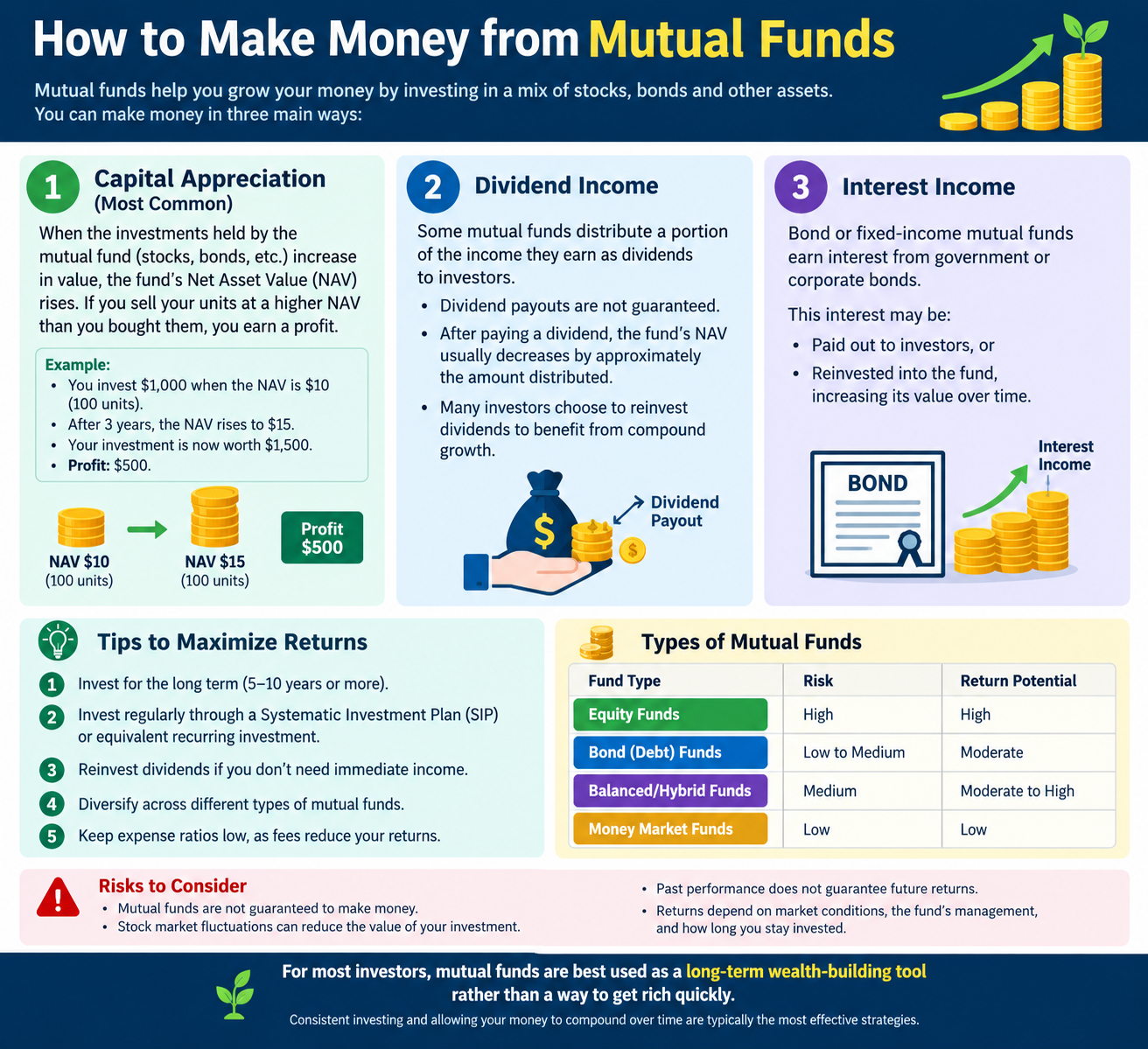
Table of Contents
- What Are Mutual Funds?
- How Do Mutual Funds Make Money?
- How to Make Money from Mutual Funds
- Choose the Right Type of Mutual Fund
- Understand Your Investment Goal
- Consider Long-Term Investing
- Reinvest Your Returns
- Understand Mutual Fund Fees
- Diversify Your Investments
- Common Mistakes to Avoid
- How Long Does It Take to Make Money from Mutual Funds?
- Beginner-Friendly Mutual Fund Action Plan
- Frequently Asked Questions
- Final Takeaway
What Are Mutual Funds?
A mutual fund is an investment vehicle that pools money from multiple investors and invests it in assets such as stocks, bonds, money-market instruments, or other securities.
Instead of buying dozens of investments yourself, you purchase shares of the mutual fund. The fund’s performance generally reflects the performance of the investments it holds, after applicable expenses.
For example, imagine a mutual fund owns shares of 50 different companies. Rather than buying shares in all 50 companies individually, an investor can purchase units of the fund and gain exposure to its portfolio.
This can make investing more convenient, especially for people who do not have the time or expertise to research individual securities.
How Do Mutual Funds Make Money?
Before learning how to make money from mutual funds, it helps to understand where potential returns come from.
Capital Appreciation
If the investments held by a mutual fund increase in value, the fund’s net asset value, or NAV, may rise.
For example, if you purchase fund units at $20 and the NAV later increases to $25, your investment has increased in value by $5 per unit before considering fees, taxes, and other factors.
However, the NAV can also fall.
Dividends and Interest
Some mutual funds receive dividends from stocks or interest from bonds and other investments.
Depending on the fund and its distribution policy, some income may be paid to investors or reinvested into the fund.
Reinvestment
Reinvesting distributions can help your investment grow over time because future returns can potentially build on previous returns.
This is one reason long-term investors often focus on consistency rather than trying to predict short-term market movements.
How to Make Money from Mutual Funds
If you want to understand how to make money from mutual funds, start by choosing funds that match your financial goals and risk tolerance.
Here are seven practical strategies to consider.
1. Invest for the Long Term
Mutual funds can be particularly useful for investors with longer time horizons.
Stock-focused funds can experience significant short-term price movements. Holding an investment for a longer period gives you more time to potentially benefit from market growth, although it does not eliminate the possibility of losses.
Instead of constantly reacting to daily market changes, long-term investors can focus on their overall financial plan.
2. Choose Funds Based on Your Goals
Different funds serve different purposes.
For example:
- Equity funds may focus on stocks and offer higher growth potential with higher risk.
- Bond funds generally invest in fixed-income securities.
- Money market funds typically invest in short-term, relatively liquid instruments.
- Balanced or hybrid funds may combine different asset classes.
- Index funds aim to track a particular market index.
Your choice should depend on factors such as your investment timeline, financial objectives, and tolerance for risk.
3. Invest Regularlyhttp://How to Make Money from Mutual Funds
Regular investing can help create a disciplined habit.
For example, an investor might decide to invest a fixed amount every month rather than waiting for what they believe is the perfect time to enter the market.
This approach can reduce the temptation to make emotional decisions based on short-term market movements.
However, regular investing does not guarantee profits or prevent losses.
4. Reinvest Distributions
If your fund offers a reinvestment option, distributions can potentially be used to purchase additional fund units.
Over a long period, those additional units may themselves generate returns.
This effect is often associated with compounding.
For example, suppose your investment generates returns and those returns remain invested. Future growth can then occur on both your original investment and the accumulated returns.
Compounding does not guarantee a positive outcome, but it can be an important part of long-term investing.
5. Pay Attention to Fees
Fees can have a meaningful impact on investment returns over time.
Before investing, check the fund’s expense ratio and other applicable charges.
Depending on the fund and platform, investors may encounter costs such as:
- Management expenses
- Expense ratios
- Sales charges
- Redemption fees
- Account or transaction fees
A fund with strong past performance is not automatically the best choice if its costs are high and its strategy does not match your goals.
6. Review Fund Performance Properly
When comparing mutual funds, do not focus only on the return from the last few months.
Look at performance over multiple periods and compare the fund with an appropriate benchmark.
Also consider the fund’s investment strategy, volatility, expenses, portfolio composition, and risk.
Past performance can provide useful information, but it does not guarantee future results.
7. Stay Consistent
One of the biggest advantages of a disciplined investing approach is that it can reduce emotional decision-making.
Markets will sometimes rise and sometimes fall. Selling everything during a market decline may prevent you from participating in a later recovery.
That does not mean investors should blindly hold every fund forever. If your financial circumstances or investment goals change, reviewing your portfolio can make sense.
Choose the Right Type of Mutual Fund
Understanding the major categories can make choosing a fund easier.
Equity Mutual Funds
Equity funds primarily invest in stocks.
They may provide greater long-term growth potential, but they can also experience significant price declines.
They may be more suitable for investors who have a longer investment horizon and can tolerate market volatility.
Bond Mutual Funds
Bond funds invest primarily in bonds and other fixed-income securities.
They may be used by investors seeking income or diversification, although bond funds also carry risks, including interest-rate and credit risk.
Money Market Mutual Funds
Money market funds generally invest in short-term, highly liquid instruments.
They are often designed to provide stability and liquidity, but they are not identical to bank deposits and are not completely risk-free.
Balanced or Hybrid Funds
These funds combine different types of investments, such as stocks and bonds.
Their goal is often to provide a mixture of growth and income while spreading exposure across asset classes.
Understand Your Risk Tolerance
Risk tolerance refers to how comfortable you are with potential losses and market fluctuations.
Suppose you invest in an equity-focused mutual fund and its value falls 20% during a market downturn. Would you panic and sell, or could you remain invested according to your long-term plan?
Your answer matters.
A fund that is appropriate for a young investor with a long time horizon may not be appropriate for someone who expects to need the money soon.
Consider:
- Your age
- Investment timeline
- Financial goals
- Income stability
- Emergency savings
- Existing investments
- Ability to tolerate losses
If you are unsure about your circumstances, consider getting advice from a qualified financial professional.
Common Mistakes to Avoid
Chasing Past Performance
A fund that performed extremely well last year may not perform equally well in the future.
Past performance should be one factor among several rather than the only reason you invest.
Ignoring Fees
Small differences in fees can become significant over long periods.
Always read the fund’s documentation and understand the costs before investing.
Investing Without a Goal
Buying a mutual fund simply because someone recommended it can lead to poor decisions.
Know why you are investing and when you may need the money.
Panic Selling
Market declines can be uncomfortable, but selling purely because of fear can turn a temporary decline into a permanent loss.
Putting Everything Into One Fund
Although mutual funds themselves may provide diversification, relying on one fund does not necessarily create a portfolio that matches your overall financial needs.
Expecting Guaranteed Returns
Mutual funds are investments, not guaranteed-income machines. Their value can rise or fall depending on the assets they hold and market conditions.
How Long Does It Take to Make Money from Mutual Funds?
There is no guaranteed timeline for making money from mutual funds.
Your results can depend on the type of fund, market conditions, investment amount, fees, taxes, and how long you remain invested.
Some investments may gain value over a relatively short period, while others can decline for extended periods.
For long-term investors, the focus is often on several years or more rather than trying to generate a profit every week or month.
The longer your investment horizon, the more important it becomes to think about compounding, costs, diversification, and risk rather than short-term market movements.
Beginner-Friendly Mutual Fund Action Plan
If you are new to mutual funds, follow these basic steps.
Step 1: Define Your Goal
Decide why you want to invest.
Your goal might be long-term wealth building, retirement planning, education expenses, or another financial objective.
Step 2: Determine Your Time Horizon
Ask yourself when you expect to need the money.
A short-term goal may require a different investment approach than a goal that is decades away.
Step 3: Understand Your Risk Level
Think about how much market volatility you can realistically tolerate.
Step 4: Research Funds
Compare:
- Investment strategy
- Historical performance
- Fees
- Risk level
- Portfolio holdings
- Benchmark
- Fund manager or management approach
Step 5: Start With an Affordable Amount
Do not invest money you need for essential expenses or emergencies.
Create a suitable financial cushion before taking significant investment risk.
Step 6: Invest Consistently
If appropriate for your circumstances, consider making regular contributions instead of constantly trying to predict market highs and lows.
Step 7: Review Periodically
Check whether your investments still match your goals.
You do not necessarily need to monitor your portfolio every day.
Frequently Asked Questions
Can you make money from mutual funds?
Yes, mutual funds can generate returns through increases in the value of their investments and, depending on the fund, dividends or interest income. However, returns are not guaranteed and investors can lose money.
How much money can I make from mutual funds?
There is no fixed amount. Your potential return depends on factors such as the fund’s investments, market performance, amount invested, fees, taxes, and investment period.
Are mutual funds safe for beginners?
Mutual funds can be a convenient way to invest, but they still carry investment risk. Different funds have different levels of risk, so beginners should understand what a fund owns before investing.
Which mutual fund is best for beginners?
There is no single best fund for everyone. The appropriate choice depends on your goals, time horizon, risk tolerance, fees, and preferred investment strategy.
Can I lose money in a mutual fund?
Yes. Mutual fund values can decline when the securities held by the fund lose value. The amount of risk depends on the fund’s investment strategy and holdings.
Should I invest in mutual funds every month?
Regular investing can be a useful way to build an investing habit and avoid relying entirely on market timing. Whether it is appropriate depends on your financial situation and investment objectives.
Are mutual funds better than individual stocks?
Neither is automatically better. Mutual funds can provide diversification and professional management, while individual stocks give investors direct ownership of specific companies. The right choice depends on your goals, knowledge, and risk tolerance.
Final Takeaway
Learning how to make money from mutual funds is mainly about building a sensible long-term investment strategy rather than searching for a quick way to become wealthy.
Start by understanding your goals, choosing funds that match your risk tolerance, comparing fees, and investing consistently when appropriate. Avoid chasing short-term performance and do not make decisions based solely on market excitement or fear.
Mutual funds can be a useful part of a diversified investment strategy, but they still involve risk. Take time to understand each fund before investing, keep your expectations realistic, and review your strategy as your financial goals change.