
How to Make Money from Dividend Stocks: 7 Smart Strategies for Beginners
Dividend stocks can be an attractive option for investors who want to combine potential stock-market growth with regular cash payments. Instead of relying only on a stock’s price increasing, dividend investors can receive distributions from companies that share part of their profits with shareholders.
If you are wondering how to make money from dividend stocks, there are two main ways to potentially benefit: receiving dividends and earning a profit if the stock price increases. However, dividends are not guaranteed, and stock prices can fall. A company can also reduce or stop its dividend.
For beginners, the most important thing is to understand how dividends work, evaluate companies carefully, and build a diversified portfolio rather than simply choosing stocks with the highest dividend yield.
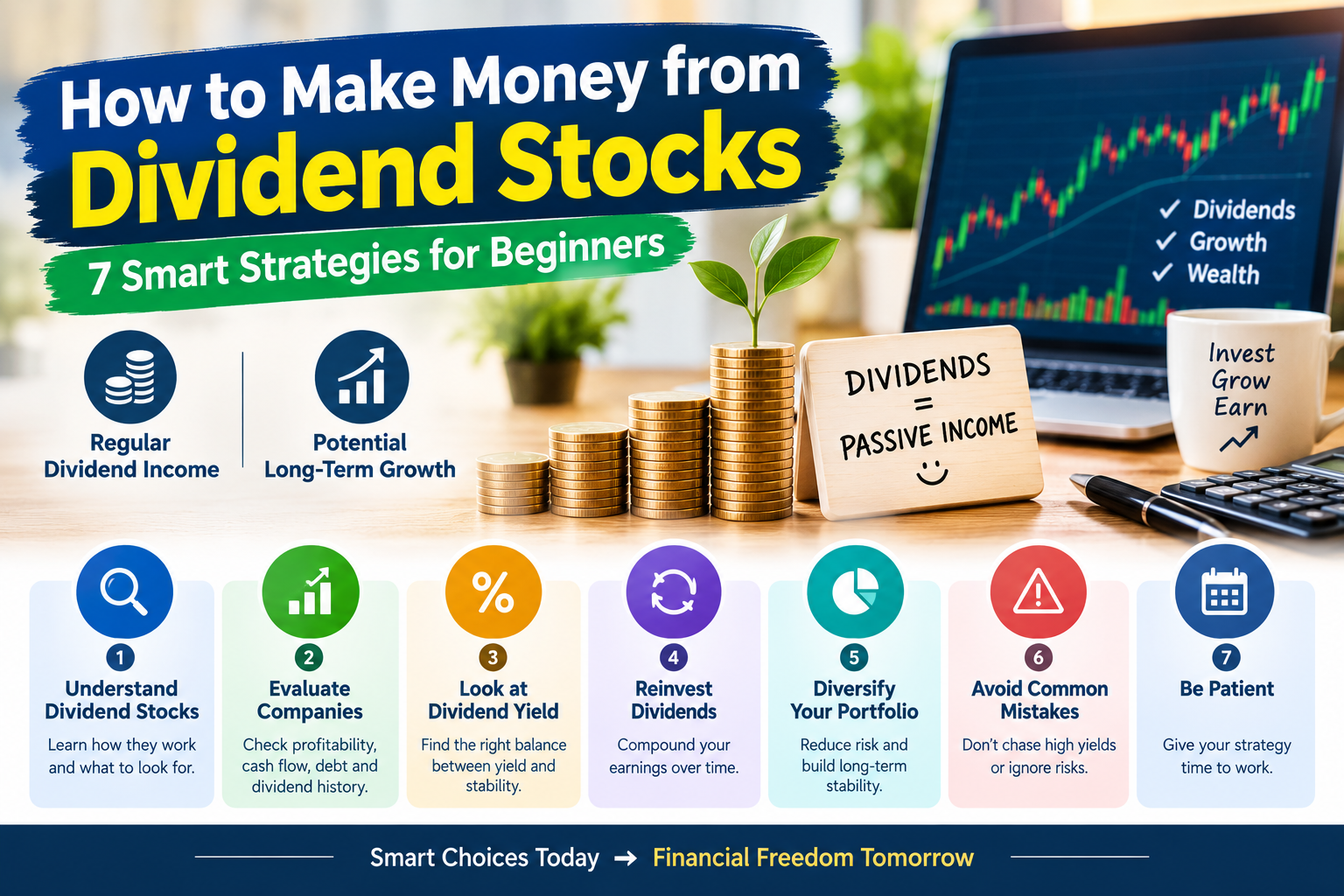
Table of Contents
- What Are Dividend Stocks?
- How Do Dividend Stocks Make Money?
- How to Make Money from Dividend Stocks
- What Is Dividend Yield?
- Look for Sustainable Dividends
- Dividend Growth vs. High Dividend Yield
- Reinvest Your Dividends
- Build a Diversified Portfolio
- Common Mistakes to Avoid
- How Long Does It Take to Make Money from Dividend Stocks?
- Beginner-Friendly Dividend Investing Action Plan
- Frequently Asked Questions
- Final Takeaway
What Are Dividend Stocks?
Dividend stocks are shares of companies that distribute part of their earnings to shareholders.
Companies may pay dividends on a quarterly, monthly, or other schedule, depending on the company and market.
For example, suppose you own 100 shares of a company and it pays an annual dividend of $2 per share. Before taxes and other considerations, you would receive $200 in annual dividend payments if the dividend remained unchanged.
The company decides whether to pay dividends and how much to distribute. A dividend is therefore not the same as guaranteed interest from a savings account.
How Do Dividend Stocks Make Money?
There are two primary ways investors can potentially make money from dividend stocks.
Dividend Income
The first is through dividend payments.
If a company continues paying dividends and you own shares on the relevant dates, you may receive cash distributions.
For investors building an income-oriented portfolio, these payments can become an important part of total returns.
Stock Price Appreciation
The second potential source of return is an increase in the stock price.
Imagine you buy shares at $50 and later sell them at $65. The $15 difference per share represents a capital gain before considering transaction costs and taxes.
If you also received dividends while holding the stock, your overall return could include both the dividends and the change in share price.
However, the opposite can happen. A stock can decline in value, potentially offsetting years of dividend income.
How to Make Money from Dividend Stocks
Learning how to make money from dividend stocks starts with looking beyond the size of a company’s dividend.
A strong dividend strategy usually considers:
- Dividend sustainability
- Company profitability
- Cash flow
- Debt levels
- Dividend history
- Earnings growth
- Industry conditions
- Valuation
- Portfolio diversification
A company offering a very high dividend yield is not automatically a better investment.
Sometimes an unusually high yield can be a warning sign that investors expect the dividend to be reduced or that the company’s share price has fallen sharply.
What Is Dividend Yield?
Dividend yield measures the annual dividend relative to a stock’s current price.
For example, if a company pays $2 per share annually and the stock trades at $50, the dividend yield is 4%.
The basic calculation is:
Dividend Yield = Annual Dividend ÷ Share Price × 100
So:
$2 ÷ $50 × 100 = 4%
Dividend yield is useful, but it should never be the only factor you consider.
A stock with a 2% yield and strong earnings growth may potentially be more attractive than a company offering 8% but struggling financially.
Look for Sustainable Dividends
A company’s ability to continue paying dividends matters more than simply looking at its current payout.
Investors can examine several indicators.
Earnings
A company needs sustainable profits to support long-term dividend payments.
If earnings are consistently falling, the dividend may become harder to maintain.
Free Cash Flow
Cash flow can provide insight into whether a company is generating enough cash from its operations to support distributions and other business needs.
Payout Ratio
The payout ratio shows how much of a company’s earnings are being distributed as dividends.
For example, if a company earns $10 per share and pays $4 per share in dividends, its payout ratio based on earnings is 40%.
A very high payout ratio can sometimes indicate that a company has less room to maintain its dividend during difficult periods, although appropriate payout ratios vary considerably by industry and business model.
Dividend Growth vs. High Dividend Yield
A common mistake is focusing only on the highest current yield.
Dividend growth can also be important.
Imagine Company A pays a 6% dividend but rarely increases it. Company B starts with a 3% yield but has a history of increasing its dividend as earnings grow.
Depending on valuation, financial strength, and an investor’s goals, Company B could potentially become increasingly attractive over a long holding period.
This is why how to make money from dividend stocks is not simply a matter of finding the stock with the biggest percentage.
Look at the complete picture.
Reinvest Your Dividends
One of the most powerful concepts in dividend investing is reinvestment.
Instead of taking dividend payments as cash, investors may choose to use them to purchase additional shares when a suitable reinvestment option is available.
Those additional shares can potentially generate future dividends.
Over many years, this process can create a compounding effect.
For example, suppose you own 100 shares and receive enough dividends to purchase two additional shares. Those two shares can potentially generate dividends in the future as well.
Of course, reinvestment does not eliminate investment risk, and dividends can be reduced or suspended.
Build a Diversified Portfolio
Putting all your money into one dividend-paying company can create unnecessary risk.
Even companies with long histories of paying dividends can face financial problems.
Diversification can help reduce the impact of a poor result from one company.
A diversified dividend portfolio might include companies from different:
- Industries
- Geographic regions
- Business models
- Market sectors
Some investors also use diversified dividend-focused funds or ETFs rather than selecting individual companies.
These products can provide exposure to multiple companies, although they still involve investment risk and have their own fees and characteristics.
Think About Total Return
Dividend income is only one part of investing.
A stock that pays a large dividend but loses significant value may produce a poor overall result.
For example, suppose you receive $5 in dividends but the share price falls by $15. Your overall return would still be negative before considering taxes and costs.
This is why investors should consider total return, which generally combines income received and changes in investment value.
A balanced approach looks at both the company’s ability to pay dividends and its long-term business prospects.
Consider Taxes and Costs
Dividend income may be taxable depending on your country, account type, and circumstances.
Capital gains can also have tax implications when you sell investments for a profit.
Brokerage fees, fund expenses, currency-conversion costs, and other charges can also affect your final return.
Before investing, understand the rules that apply to you. Tax treatment can vary significantly between countries and individual circumstances.
Common Mistakes to Avoid
Chasing the Highest Yield
A high dividend yield can look attractive, but it may come with higher risk.
Always investigate why the yield is unusually high.
Ignoring the Business
A dividend comes from a company. If the underlying business is weak, the dividend may not remain sustainable.
Buying Only Because of a Dividend
A dividend should not be the only reason you purchase a stock.
Consider valuation, financial health, growth prospects, and risk.
Forgetting Diversification
Even a strong company can experience unexpected problems.
Avoid relying too heavily on one stock or sector.
Selling During Every Market Decline
Stock prices fluctuate.
If your investment thesis remains intact, short-term price movements may not necessarily mean the company has become a bad investment. However, investors should still review their holdings when circumstances change.
Expecting Guaranteed Income
Dividends can be reduced or eliminated. Companies are not required to maintain the same dividend forever.
How Long Does It Take to Make Money from Dividend Stocks?
There is no guaranteed timeline.
Dividend investing is generally better suited to investors who can think in years rather than days or weeks.
Your results can depend on:
- Amount invested
- http://How to Make Money from Dividend StocksDividend yield
- Dividend growth
- Stock price performance
- Reinvestment
- Fees
- Taxes
- Market conditions
For example, an investor contributing $200 per month will have a different outcome from someone investing $2,000 per month.
The key advantage of a long-term approach is that regular contributions and reinvested dividends can potentially compound over time.
Beginner-Friendly Dividend Investing Action Plan
If you want to start learning how to make money from dividend stocks, follow a simple process.
Step 1: Define Your Goal
Decide whether you want current income, long-term growth, or a combination of both.
Step 2: Learn Dividend Basics
Understand dividend yield, payout ratio, dividend growth, earnings, cash flow, and total return.
Step 3: Create a Watchlist
Research companies with sustainable businesses and consistent financial performance.
Do not buy immediately. Compare several companies first.
Step 4: Check the Dividend
Look at the company’s dividend history and determine whether the current payment appears sustainable based on its financial position.
Step 5: Examine the Business
Research revenue, earnings, debt, competitive position, and industry conditions.
Step 6: Consider Diversification
Avoid putting your entire portfolio into one company or sector.
Step 7: Decide What to Do With Dividends
You can potentially reinvest them or use them as income, depending on your financial goals.
Step 8: Review Your Portfolio
Check your investments periodically rather than reacting to every daily price movement.
Frequently Asked Questions
Can you make money from dividend stocks?
Yes. Investors can potentially earn money through dividend payments and stock price appreciation. However, dividends are not guaranteed and stock prices can decline.
How much money do I need to make $100 a month in dividends?
The amount depends on the portfolio’s dividend yield. For example, a 4% annual yield would require approximately $30,000 invested to generate $1,200 per year before taxes and assuming the yield remains unchanged. Actual results can vary.
Are dividend stocks safe?
Dividend stocks are not risk-free. Companies can reduce or eliminate dividends, and share prices can fall significantly.
Is a high dividend yield better?
Not necessarily. A high yield can sometimes indicate higher risk. Investors should examine the company’s financial health, payout ratio, cash flow, and business outlook.
Should I reinvest dividends?
Reinvesting dividends can help build additional shares and potentially increase long-term compounding. However, whether reinvestment is appropriate depends on your financial goals.
Can dividend stocks make you rich?
There are no guaranteed paths to wealth through dividend stocks. Long-term investing, regular contributions, diversification, and reinvestment can potentially build wealth, but investment values can also decline.
How often do dividend stocks pay?
Many companies pay dividends quarterly, but payment schedules vary. Some companies may pay monthly, semi-annually, or annually depending on their policies and market.
Final Takeaway
Learning how to make money from dividend stocks is about much more than finding companies with the highest dividend yields.
A sensible dividend strategy focuses on financially healthy businesses, sustainable dividends, reasonable valuations, diversification, and long-term discipline. Reinvesting dividends can also help create a compounding effect over time.
Remember that dividends are not guaranteed, and even established companies can experience financial difficulties. Research each investment carefully, understand the risks, and consider your own financial goals before investing.
The strongest approach is usually to focus on the quality and sustainability of the investment rather than chasing the biggest dividend payment available.