
How to Make Money from AI Voiceover Services: 7 Smart Ways to Get Started
AI voice technology has changed the way businesses, creators, educators, and marketers produce audio content. Professional voiceovers that once required recording studios, microphones, and long editing sessions can now be created with modern text-to-speech tools.
If you are wondering how to make money from AI voiceover services, there are several opportunities to explore. You can create voiceovers for YouTube videos, advertisements, online courses, podcasts, social media content, presentations, audiobooks, and other digital projects.
The technology is useful, but simply generating an AI voice is not enough to build a successful service. Clients still need good scripts, natural pacing, clean audio, appropriate pronunciation, editing, and reliable delivery. The real opportunity is to combine AI tools with human creativity and quality control.
It is also important to use voices responsibly. If you create a custom or cloned voice, make sure you have the speaker’s permission and the necessary rights. Microsoft, for example, requires explicit written permission for custom neural voices and emphasizes transparency around synthetic voices. (Microsoft Learn)
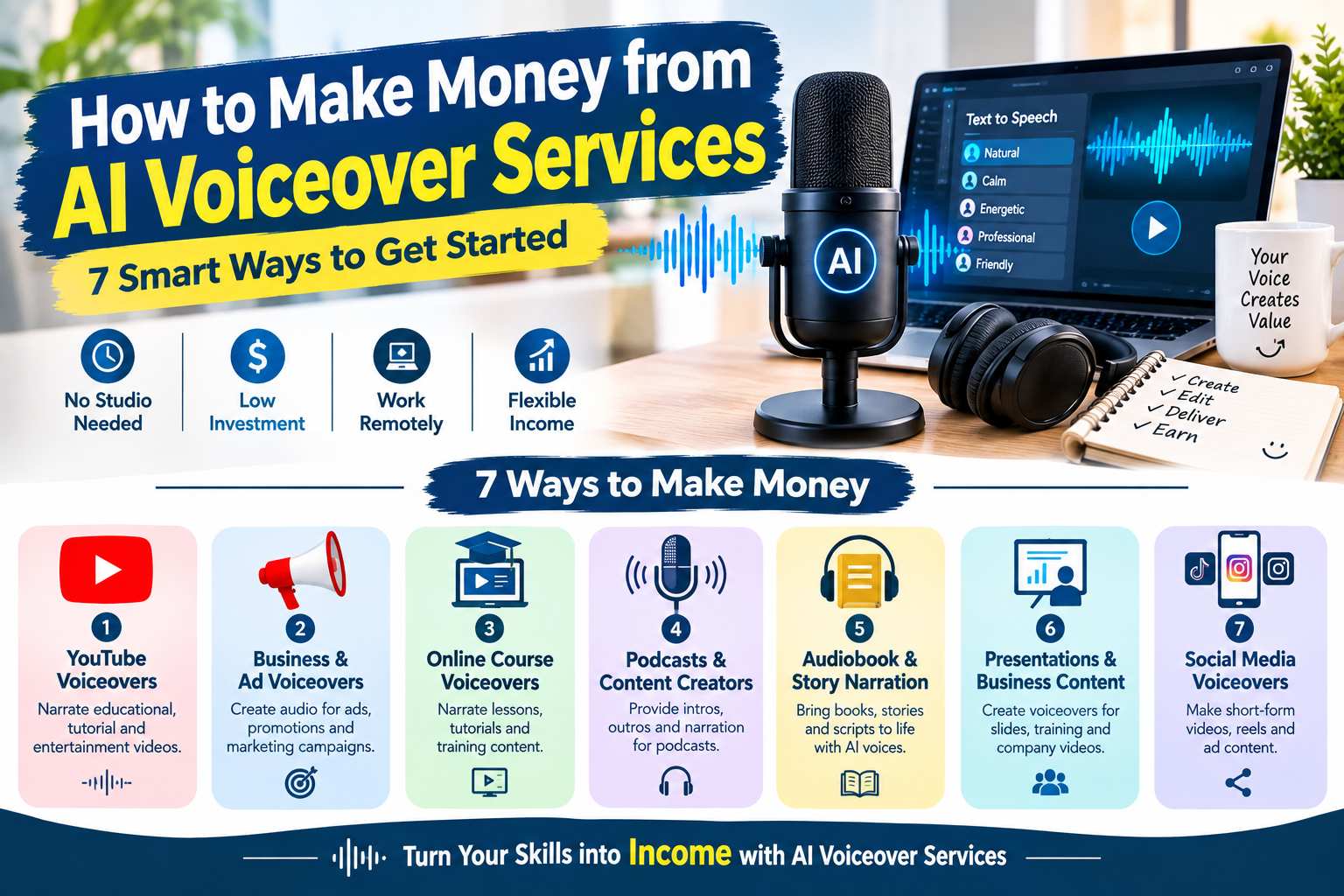
Table of Contents
- What Are AI Voiceover Services?
- How to Make Money from AI Voiceover Services
- Choose a Profitable Voiceover Niche
- Create YouTube Voiceovers
- Offer Voiceovers for Businesses
- Create Voiceovers for Online Courses
- Work With Podcasters and Content Creators
- Offer Audiobook and Story Narration
- Sell AI Voiceover Packages
- Build a Professional Portfolio
- How to Find Your First Clients
- Price Your AI Voiceover Services
- Use AI Responsibly
- Common Mistakes to Avoid
- How Long Does It Take to Make Money?
- Beginner-Friendly AI Voiceover Action Plan
- Frequently Asked Questions
- Final Takeaway
What Are AI Voiceover Services?
AI voiceover services use text-to-speech technology to turn written scripts into spoken audio.
Modern synthetic voices can produce different languages, accents, tones, and speaking styles. This makes them useful for businesses and creators who need audio content without arranging a traditional recording session.
For example, a small business could provide a 500-word promotional script and ask a voiceover freelancer to turn it into polished narration for a social media advertisement.
The freelancer’s job is not simply to press a “generate” button. They may need to edit the script, choose an appropriate voice, adjust pronunciation, control pauses, remove unwanted sections, add music or sound effects, and deliver the final audio in the client’s preferred format.
That service layer is where much of the potential business value exists.
How to Make Money from AI Voiceover Services
Learning how to make money from AI voiceover services starts with choosing a specific service and target customer.
Instead of saying that you create “AI voices for everyone,” you could specialize in one area, such as:
- YouTube narration
- Short-form video voiceovers
- Product advertisements
- Online course narration
- Podcast intros
- Explainer videos
- Audiobook narration
- E-learning content
- Social media advertisements
- Business presentations
A focused service makes it easier to create a portfolio and explain your offer to potential clients.
Choose a Profitable Voiceover Niche
Your first decision should be choosing a niche you can serve consistently.
YouTube Voiceovers
YouTube creators often need narration for educational videos, documentaries, tutorials, list videos, and other formats.
You can offer:
- Script-to-voice conversion
- Multiple voice styles
- Background music
- Audio cleanup
- Timing adjustments
- Subtitle-ready audio
A creator who publishes several videos each month may need recurring voiceover support.
Advertising Voiceovers
Businesses need audio for promotional videos, social media advertisements, product demonstrations, and marketing campaigns.
Advertising requires extra care because the voice should match the brand’s tone.
A luxury product may require a calm and sophisticated delivery, while a children’s product may need a more energetic style.
Educational Voiceovers
Online educators and course creators need narration for lessons, presentations, tutorials, and training materials.
This type of work can involve longer scripts, so consistency and pronunciation become particularly important.
Create YouTube Voiceovers
One of the simplest ways to start an AI voiceover service is to work with YouTube creators.
Search for channels that produce content in a niche you understand. Study their existing videos and identify whether professional narration could improve their content.
You can offer a simple package such as:
Basic YouTube Voiceover
- Script up to a specified word count
- AI voice generation
- Basic editing
- MP3 delivery
You can create additional packages for longer scripts, faster delivery, multiple voices, or advanced editing.
Do not promise specific results such as guaranteed views or subscribers. Your service provides production support, not guaranteed channel growth.
Offer Voiceovers for Businesses
Businesses increasingly use video and audio in their marketing.
Potential clients include:
- Restaurants
- Online stores
- Software companies
- Real estate businesseshttp://How to Make Money from AI Voiceover Services
- Marketing agencies
- Educational companies
- Local service businesses
For example, an online store might need a short voiceover explaining how a product works.
You could create the narration and synchronize it with the company’s existing video.
Create Voiceovers for Online Courses
Online courses often contain dozens of lessons, making consistent narration valuable.
A course creator may provide written lesson scripts, and you can turn those scripts into organized audio files.
A professional workflow could include:
- Review the script.
- Identify difficult words and names.
- Select an appropriate voice.
- Generate the narration.
- Listen for pronunciation problems.
- Adjust pauses and pacing.
- Remove mistakes.
- Export the final audio.
- Organize files by lesson.
- Deliver the completed project.
For larger projects, organization can be just as important as the voice quality.
Work With Podcasters and Content Creators
Podcasters may need short voice segments such as:
- Introductions
- Outros
- Advertisements
- Chapter transitions
- Character voices
- Announcements
You can also offer audio editing alongside voice generation.
This creates a more complete service because the client receives a finished audio asset instead of an unedited AI-generated file.
Offer Audiobook and Story Narration
AI-generated narration can be useful for certain audiobook, story, educational, and fictional projects, but commercial rights and platform requirements must be checked carefully before selling or distributing the work.
If a client wants a voice based on a real person, obtain appropriate permission and documentation. Do not clone a celebrity, actor, creator, or other person’s recognizable voice without authorization.
You should also check the commercial-use terms of the AI voice provider you use.
Sell AI Voiceover Packages
Packaging your services can make your business easier to understand.
For example:
Starter Package
- Short script
- One AI voice
- Basic editing
- MP3 file
Professional Package
- Longer script
- Voice selection
- Pronunciation adjustments
- Audio cleanup
- Background music where appropriate
Business Package
- Multiple voiceovers
- Brand-specific style
- Multiple file formats
- Faster delivery
- Revisions
The exact prices should depend on your market, workload, tool costs, editing time, and the value you provide.
Build a Professional Portfolio
Before searching for clients, create several sample projects.
You do not need real customers for every sample.
Create fictional examples such as:
- A product advertisement
- A YouTube documentary introduction
- An educational lesson
- A podcast advertisement
- A real estate video
- A short social media advertisement
Use different voices and styles to demonstrate what you can do.
Your portfolio should show quality rather than quantity.
How to Find Your First Clients
Once your samples are ready, start contacting potential customers.
Freelance Platforms
You can create a service listing on freelance marketplaces and describe exactly what you provide.
Avoid generic descriptions such as “I will make AI voiceovers.”
Instead, explain the result:
“I will create natural-sounding AI narration for YouTube videos, advertisements, and educational content.”
Direct Outreach
You can also contact businesses and creators directly.
Keep your message short and personalized.
Mention something specific about their content and explain how your service could help.
Social Media
Post short samples demonstrating different voiceover styles.
Before-and-after examples can be particularly useful because they show how editing and production improve raw narration.
Price Your AI Voiceover Services
There is no universal price for AI voiceover work.
Your pricing can depend on:
- Word count
- Project length
- Voice type
- Editing requirements
- Number of revisions
- Background music
- File formats
- Delivery speed
- Commercial usage
- Your software costs
Avoid competing only on the lowest price.
If you provide script editing, pronunciation correction, audio mixing, and professional delivery, you are offering more than raw text-to-speech generation.
Use AI Responsibly
Responsible voice usage is essential for anyone building an AI voiceover business.
Do not use someone’s voice without permission. Microsoft specifically recommends obtaining permission from voice talent and ensuring agreements cover intended uses and limitations. (Microsoft Learn)
You should also avoid using synthetic voices to impersonate people or mislead audiences. Microsoft’s responsible-use guidance prohibits impersonation without permission and deceptive or misleading uses. (Microsoft Learn)
Transparency can also matter. Microsoft recommends disclosing synthetic voices in appropriate contexts, while YouTube requires disclosure for certain realistic AI-generated or meaningfully altered content. (Microsoft Learn)
Before delivering commercial work, check:
- Whether your AI tool permits commercial use
- Whether your plan includes the necessary rights
- Whether voice cloning requires consent
- Whether the client needs disclosure
- Whether the publishing platform has AI-content rules
- Whether local laws or contracts impose additional requirements
Common Mistakes to Avoid
Selling Raw AI Output
Generating a voice and immediately sending the file to a client provides limited value.
Add editing, quality control, pronunciation corrections, and proper formatting.
Using Unauthorized Voice Clones
Never assume that a voice available online is free to clone.
Use your own voice, properly licensed voices, or voices for which you have explicit permission.
Ignoring Commercial Licensing
A voice tool may have different rules for personal and commercial use.
Read the provider’s current terms before selling generated audio.
Choosing the Wrong Voice
A voice that sounds excellent in one project may be unsuitable for another.
Match the voice to the audience, subject, brand, and tone.
Poor Pronunciation
AI voices can sometimes mispronounce names, technical terms, abbreviations, or unusual words.
Listen to every finished project before delivering it.
Competing Only on Price
Cheap services can attract customers, but extremely low pricing can make it difficult to cover software costs and editing time.
Focus on quality, reliability, and a clear niche.
Expecting Instant Income
AI tools can make production faster, but finding customers still takes effort.
Building a reputation and repeat-client base takes time.
How Long Does It Take to Make Money?
There is no guaranteed timeline.
A beginner who already understands audio editing and online freelancing may find opportunities sooner than someone starting from scratch.
Your progress depends on factors such as:
- Portfolio quality
- Niche selection
- Pricing
- Outreach
- Communication skills
- Audio quality
- Client demand
- Consistency
Instead of focusing only on your first payment, focus on building a repeatable system.
A client who orders one voiceover today could potentially become a recurring customer if you provide reliable quality and communication.
Beginner-Friendly AI Voiceover Action Plan
Step 1: Learn the Basics
Understand text-to-speech, voice selection, pronunciation controls, audio formats, and basic editing.
Step 2: Choose One Niche
Start with YouTube narration, advertisements, educational content, or another specific category.
Step 3: Create Five Samples
Make five high-quality samples that demonstrate different styles.
Step 4: Build Your Service
Create one simple package with a clear word limit, delivery time, revision policy, and file format.
Step 5: Find Potential Customers
Contact creators, agencies, educators, and businesses that already produce video or audio content.
Step 6: Deliver Professionally
Check pronunciation, pacing, volume, and background noise before sending the final file.
Step 7: Build Repeat Business
Ask satisfied clients whether they need regular voiceover work.
Recurring projects can be more valuable than constantly searching for new customers.
Frequently Asked Questions
Can beginners make money from AI voiceover services?
Yes. Beginners can offer AI-assisted voiceover services for videos, advertisements, courses, podcasts, and other projects. However, earning money requires more than generating audio; quality, editing, marketing, and client service are important.
Do I need expensive equipment?
Not necessarily. Since the voice itself can be generated digitally, you may not need a professional recording studio. A computer, suitable AI voice tool, editing software, and reliable internet connection can be enough to get started.
Can I sell AI-generated voiceovers commercially?
This depends on the AI tool, subscription plan, voice license, and intended use. Always check the current commercial-use terms before selling generated audio.
Can I clone another person’s voice?
Only do so when you have the necessary permission and rights. Using someone’s recognizable voice without authorization can create legal, ethical, and platform-policy problems. Microsoft’s guidance specifically emphasizes consent for custom voice models. (Microsoft Learn)
What services can I offer with AI voiceovers?
You can offer YouTube narration, advertisements, educational narration, podcast intros, explainer videos, social media content, audiobook-related work, and audio editing.
How can I find my first AI voiceover client?
Build several samples first, then contact creators, businesses, educators, agencies, and other potential customers. Freelance platforms and direct outreach can both be useful.
Can AI voiceover become a full-time business?
It can become part of a larger freelance or digital-content business, but there is no guaranteed income level. Building recurring clients, improving quality, and expanding your services can create more opportunities over time.
Final Takeaway
Learning how to make money from AI voiceover services is about turning AI technology into a useful service rather than simply generating synthetic speech.
Choose a specific niche, create strong samples, learn basic audio editing, build clear service packages, and focus on delivering reliable results. You can start with small projects and gradually work toward recurring clients and larger commercial jobs.
Most importantly, use synthetic voices responsibly. Get permission before cloning someone’s voice, follow the licensing terms of your AI provider, and disclose synthetic content when required or appropriate. These practices help protect both your business and the people whose voices are involved. (Microsoft Learn)