
How to Make Money From Amazon: 7 Proven Ways
Have you ever wondered how people make money from Amazon without necessarily creating a huge online store of their own?
Amazon is more than a place to buy products. It has created several opportunities for sellers, authors, creators, affiliates, and entrepreneurs to build online income streams.
You can sell physical products, publish books, promote products through affiliate marketing, create merchandise, or build a brand around your own products. Amazon also provides tools for sellers to manage listings, inventory, orders, advertising, and fulfillment. (Amazon Seller Central)
The important thing to remember is that making money from Amazon is not guaranteed or instant. Every method requires research, consistency, and a strategy.
So, which options are available?
Let’s explore seven practical ways to make money from Amazon.
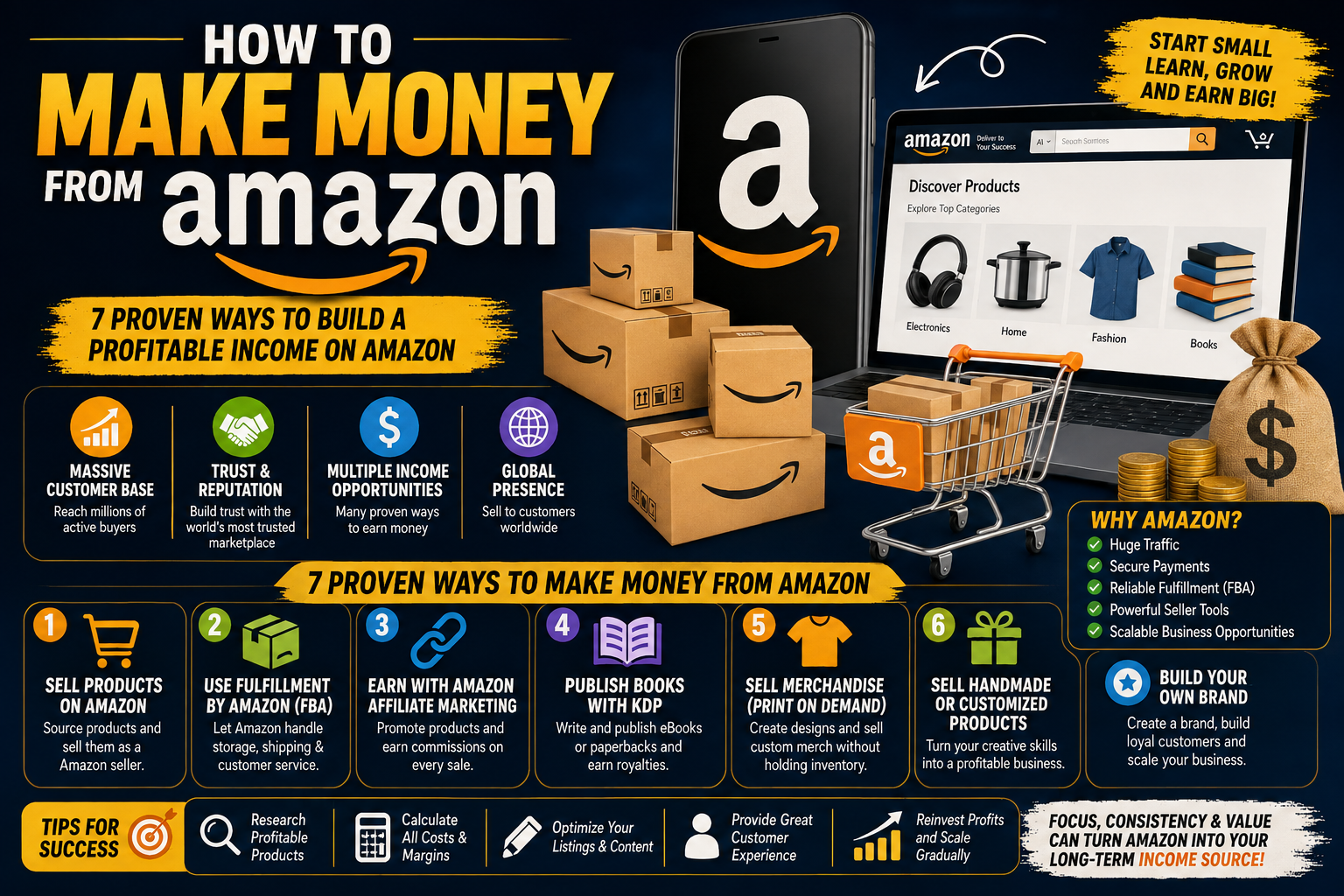
Table of Contents
- What Is Amazon Monetization?
- 7 Ways to Make Money From Amazon
- How to Choose the Right Amazon Business Model
- How to Find Profitable Products
- How to Start Selling on Amazon
- Common Amazon Money-Making Mistakes
- Beginner Action Plan
- How Long Does It Take to Make Money From Amazon?
- FAQs
- Final Takeaway
What Is Amazon Monetization?
Amazon monetization means using Amazon’s marketplace, publishing platforms, creator programs, or affiliate opportunities to generate income.
There is no single Amazon business model.
Depending on your skills and budget, you could:
- Sell physical products
- Use Fulfillment by Amazon
- Publish books through Kindle Direct Publishing
- Promote products as an Amazon Associate
- Sell print-on-demand merchandise
- Sell handmade or customized products
- Build your own brand
Some methods require upfront investment, while others can be started with relatively little inventory or capital.
The right option depends on what you want to build.
7 Ways to Make Money From Amazon
1. Sell Products on Amazon
One of the most direct ways to make money from Amazon is to become a seller.
You can research products, source them, create listings, set prices, and sell them to Amazon customers.
Amazon’s Seller Central provides tools for managing products, inventory, orders, payments, promotions, advertising, and performance. (Sell on Amazon)
You can sell products under different business models, including your own branded products, wholesale products, handmade items, or other products that comply with Amazon’s policies.
The basic process looks like this:
Research → Source → List → Price → Market → Sell → Fulfill → Analyze
Your profit comes from the amount left after product costs, Amazon fees, fulfillment expenses, advertising, and other business costs.
That’s why calculating your margins before buying inventory is extremely important.
2. Use Fulfillment by Amazon
If managing shipping and customer orders sounds difficult, Fulfillment by Amazon (FBA) can help.
With FBA, you send eligible inventory to Amazon’s fulfillment network, and Amazon can handle tasks such as storage, order fulfillment, customer service, and returns. (Sell on Amazon)
This can make your business easier to scale because you do not have to personally package and ship every order.
However, FBA is not free.
You need to understand storage, fulfillment, selling, and other applicable costs before deciding whether a product makes financial sense.
A simple rule is:
Revenue − Product Cost − Amazon Fees − Fulfillment − Advertising − Other Expenses = Profit
Never confuse sales with profit.
3. Make Money With Amazon Affiliate Marketing
If you have a website, blog, social media audience, or another eligible platform, Amazon Associates can provide another way to earn.
The basic idea is straightforward.
You recommend products using your Amazon affiliate links.
When someone follows your link and makes a qualifying purchase, you may earn a referral commission. Amazon’s official Associates documentation explains that commissions are generated when visitors follow qualifying links and make qualifying purchases. (Amazon Associates)
For example, you could create content about:
- Technology
- Home products
- Fitness equipment
- Books
- Kitchen tools
- Photography equipment
- Office products
The best affiliate content usually helps people make decisions.
Instead of simply saying, “Buy this product,” you could create comparisons, guides, reviews, and buying recommendations.
That gives your audience a reason to trust your content.
4. Publish Books With Amazon KDP
If you enjoy writing, Kindle Direct Publishing (KDP) provides another opportunity.
KDP allows authors to publish ebooks and print books through Amazon.
You could create:
- Practical guides
- Fiction
- Educational books
- Workbooks
- Journals
- Activity books
- Niche reference books
But publishing a book is only the first step.
Competition is significant, so your book needs a useful topic, professional presentation, and a strong description.
Amazon itself recommends paying attention to elements such as the cover, proofreading, description, author profile, and promotion when marketing a KDP book. (Amazon Kindle Direct Publishing)
If you already have an audience, you can also use your website or social media accounts to promote your books.
5. Sell Merchandise With Print on Demand
If you are interested in design, Amazon can also be used for merchandise.
Amazon’s Merch on Demand program allows creators to upload designs for products such as apparel and sell them without managing traditional inventory, printing, or shipping themselves. Products are produced after sales and can be fulfilled through Amazon. (Sell on Amazon)
This can be useful if you have creative ideas but don’t want to purchase hundreds of T-shirts in advance.
You could create designs around specific interests, hobbies, professions, or communities.
For example:
- Gaming
- Fitness
- Pets
- Travel
- Books
- Food
- Humor
- Hobbies
The key is creating original designs that appeal to a specific audience.
Avoid using copyrighted characters, logos, or trademarked phrases unless you have the appropriate rights.
6. Sell Handmade or Customized Products
If you make products yourself, Amazon can also provide a marketplace for handmade or customized goods.
Depending on the program and eligibility, sellers can offer products that have a personal or creative element.
Examples could include:
- Handmade decorations
- Personalized gifts
- Jewelry
- Home accessories
- Custom artwork
- Craft products
The advantage is that unique products can give you a different position from sellers competing mainly on price.
However, you still need to consider production time, materials, packaging, shipping, and customer service.
7. Build Your Own Amazon Brand
Instead of simply selling individual products, you can build a recognizable brand.
A brand gives customers a reason to remember your products.
For example, instead of selling one generic water bottle, you could develop a complete brand around fitness and outdoor products.
You might eventually have:
- Multiple related products
- Consistent packaging
- A Brand Store
- A recognizable visual identity
- Product bundles
- Repeat customers
Amazon provides Brand Registry and other brand-building tools for eligible brands, including features such as Brand Stores, A+ Content, analytics, and advertising options. (Sell on Amazon)
This approach can take more time and investment, but it can also give you greater control over the business.
How to Choose the Right Amazon Business Model
Not every Amazon method is right for everyone.
Think about your situation before choosing one.
If you have limited money
You may want to explore options such as affiliate marketing, KDP, or merchandise programs, depending on your eligibility and skills.
If you enjoy product research
Selling physical products may be a better fit.
If you enjoy writing
KDP could be worth exploring.
If you enjoy design
Print-on-demand merchandise may be interesting.
If you already have an audience
Affiliate marketing or promoting your own products can become powerful options.
The best business model is usually the one that matches your skills, resources, and ability to stay consistent.
How to Find Profitable Products
If you decide to sell physical products, product research is extremely important.
Do not choose a product simply because it looks popular.
Look at:
- Customer demand
- Competition
- Selling price
- Product cost
- Amazon fees
- Shipping costs
- Potential profit margin
- Customer reviews
- Product size and weight
- Potential return rates
- Opportunities for differentiation
Customer reviews can be particularly useful.
Look at negative reviews and ask:
What are customers complaining about?
Those complaints may reveal opportunities to improve an existing product.
For example, customers might complain about poor packaging, weak materials, confusing instructions, or a missing feature.
Instead of copying an existing product, you can use this information to think about how your own product could provide a better experience.
How to Start Selling on Amazon
If you want to sell physical products, the process generally begins with creating a Seller Central account.
Amazon’s current Seller Central process involves registering as a seller, providing business and product information, verifying your identity, and setting up your account. (Sell on Amazon)
You then need to:
Step 1: Choose a Product
Research demand, competition, costs, and potential margins.
Step 2: Source the Product
Find a reliable supplier or create the product yourself.
Step 3: Create Your Listing
Use clear product images, an accurate title, useful bullet points, and a detailed description.
Step 4: Set Your Price
Calculate all costs before deciding on your selling price.
Step 5: Choose Fulfillment
Decide whether you will fulfill orders yourself or use a service such as FBA.
Step 6: Market Your Product
Amazon provides advertising and promotional tools that sellers can use to increase product discovery. (Amazon Seller Central)
Step 7: Study Your Results
Track sales, expenses, conversion, customer feedback, and other performance data.
Then improve your listings and products based on what you learn.
Common Amazon Money-Making Mistakes
Choosing a Product Without Research
A product can look exciting but still be difficult to sell profitably.
Always research before investing.
Focusing Only on Sales
High sales numbers do not necessarily mean high profits.
Calculate your complete costs.
Ignoring Customer Reviews
Reviews can reveal problems with your product or competitors’ products.
Use that information to improve.
Competing Only on Price
Trying to become the cheapest seller can create a difficult business model.
Look for ways to differentiate through quality, branding, features, packaging, or customer experience.
Spending Too Much Too Early
You do not need to invest heavily before testing your idea.
Start carefully, learn the market, and reinvest when the numbers make sense.
Depending on One Income Stream
Amazon can be an excellent platform, but platform rules and market conditions can change.
Building additional assets such as a website, email list, social audience, or brand can give you more long-term control.
Beginner Action Plan
If you are completely new to Amazon, keep your first steps simple.
Week 1: Choose Your Method
Decide whether you want to sell products, publish books, use affiliate marketing, create merchandise, or pursue another Amazon opportunity.
Week 2: Research
Study successful businesses in your chosen area.
Look at their products, content, pricing, customer reviews, and marketing.
Week 3: Create Your First Asset
Depending on your model, this could be:
- Your first product listing
- Your first KDP book
- Your first affiliate content
- Your first merchandise designs
Week 4: Launch and Learn
Publish your content or products.
Track the results.
Do not expect everything to work perfectly on your first attempt.
Use the data to improve.
How Long Does It Take to Make Money From Amazon?
There is no guaranteed timeline.
Some people may generate their first sale relatively quickly, while others may spend months researching products, building listings, or growing an audience.
Your results can depend on:
- Business model
- Product demand
- Competition
- Content quality
- Pricing
- Marketing
- Customer experience
- Available capital
- Consistency
Treat the beginning as a learning period.
Your goal should not simply be to make one sale.
You want to understand why people buy and build a repeatable system around that knowledge.
FAQs
Can I make money from Amazon?
Yes. Amazon offers several ways to generate income, including selling products, affiliate marketing, KDP publishing, merchandise, and other programs. (Sell on Amazon)
Can I make money from Amazon without selling physical products?
Yes. Affiliate marketing, KDP publishing, and certain creator or merchandise programs can allow you to earn without running a traditional inventory-based store.
How much money do I need to start selling on Amazon?
There is no single amount that works for everyone. Your costs depend on your business model, products, inventory, selling plan, fulfillment, advertising, and other expenses.
Amazon currently lists an Individual selling plan at $0.99 per item sold and a Professional plan at $39.99 per month, in addition to applicable selling fees. (Sell on Amazon)
Is Amazon FBA worth it for beginners?
It can be, but you need to calculate your costs carefully. FBA can handle fulfillment, customer service, and returns, but sellers still need to understand the associated fees and inventory requirements. (Sell on Amazon)
Can I make money from Amazon with affiliate marketing?
Yes. Amazon Associates allows eligible participants to earn referral commissions from qualifying purchases generated through their affiliate links. (Amazon Associates)
Is Amazon a good way to make passive income?
Some Amazon business models can become more automated over time, but none should be assumed to be completely passive. Product research, marketing, customer experience, content creation, and business management can still require ongoing work.
Final Takeaway
Making money from Amazon is possible, but there is no single shortcut that guarantees success.
You can sell physical products, use FBA, promote products through affiliate marketing, publish books with KDP, create merchandise, sell handmade products, or build your own Amazon brand.
The smartest approach is to choose one model and learn it properly instead of trying everything at once.
Start small.
Research before spending money.
Understand your customers.
Track your actual profit.
Then improve what works.
Amazon gives you access to a massive marketplace, but the platform itself does not guarantee success. Your results will ultimately depend on the value you provide, the strategy you choose, and how consistently you execute it.