
How to Make Money From Etsy: 7 Proven Ways
Have you ever wondered how people make money selling products on Etsy without opening a traditional physical store?
Etsy has become a popular marketplace for unique, creative, handmade, personalized, and digital products. Sellers can use the platform to reach customers who are already looking for products with a more personal or creative touch. Etsy’s current seller rules allow products that are made, designed, handpicked, or appropriately sourced by the seller, subject to its policies. (Etsy Help)
The interesting part is that you do not necessarily need to manufacture physical products yourself.
You can sell digital downloads, original designs through a production partner, handmade products, personalized items, vintage products, and other eligible products.
But Etsy is not a magic button for instant income.
You still need good products, attractive listings, proper pricing, customer service, and a strategy for getting your products in front of the right buyers.
So, how can you make money from Etsy?
Let’s explore seven practical ways to start.
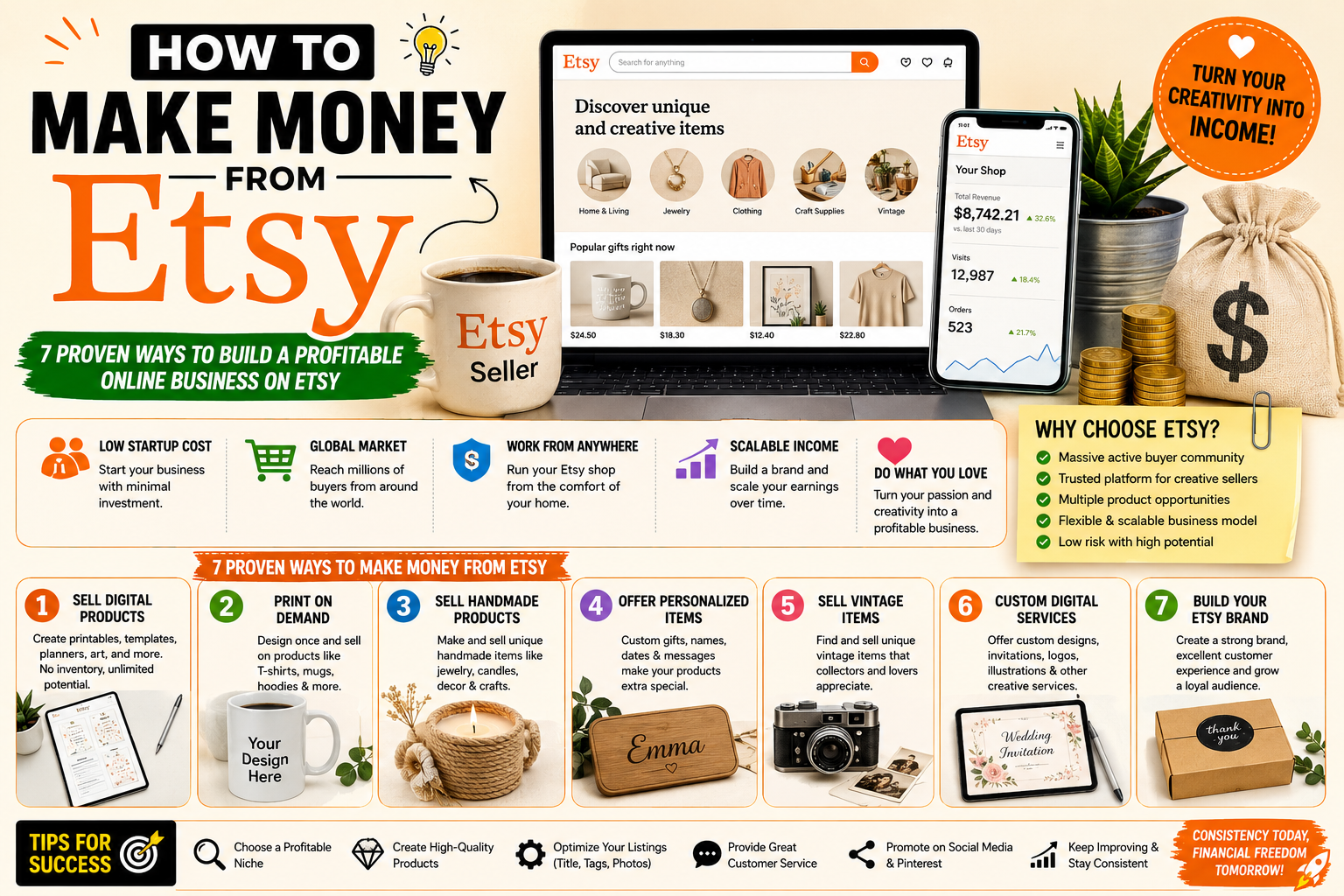
Table of Contents
- What Is Etsy?
- How Does Making Money on Etsy Work?
- 7 Ways to Make Money From Etsy
- How to Choose a Profitable Etsy Niche
- How to Create Products People Want to Buy
- How to Price Etsy Products
- How to Get More Customers on Etsy
- Common Etsy Selling Mistakes
- Beginner Action Plan
- How Long Does It Take to Make Money From Etsy?
- FAQs
- Final Takeaway
What Is Etsy?
Etsy is an online marketplace focused on creative and unique products.
Unlike a general marketplace where almost anything can be sold, Etsy’s policies focus on products that are made, designed, handpicked, or sourced according to its Creativity Standards. (Etsy Help)
This makes Etsy particularly interesting for people who create designs, crafts, personalized products, digital files, and other creative goods.
For example, an Etsy shop could sell:
- Digital planners
- Resume templates
- Printable wall art
- Wedding invitations
- Handmade jewelry
- Personalized gifts
- T-shirts
- Stickers
- Home decorations
- Vintage items
The key is finding a specific audience and creating something that audience actually wants.
How Does Making Money on Etsy Work?
The basic Etsy business model is simple:
Choose a niche → Create a product → Open your shop → Create a listing → Get visitors → Make sales → Deliver the product → Earn profit
Your profit is not simply the selling price.
You need to consider product costs, Etsy fees, payment processing, advertising, production, shipping, and other expenses.
For example, Etsy currently charges a $0.20 USD listing fee and a 6.5% transaction fee, while payment-processing fees vary by country. Additional fees may apply depending on services such as Offsite Ads or currency conversion. (Etsy Help)
That is why calculating your real profit before launching a product is important.
7 Ways to Make Money From Etsy
1. Sell Digital Products
Digital products are one of the most interesting Etsy business models because there is no physical inventory to store or ship.
You create a digital file once and can potentially sell it repeatedly.
Etsy supports digital listings as either instant downloads or made-to-order digital products. Digital items must be made and/or designed by the seller. (Etsy Help)
Examples include:
- Planners
- Calendars
- Resume templates
- Social media templates
- Printable artwork
- Wedding invitations
- Worksheets
- Budget spreadsheets
- Business templates
- Educational resources
For example, you could create a professional budget planner for people who want to manage their monthly expenses.
Once the file is created, customers can purchase it and receive the digital product without you having to package or ship anything.
This can make digital products relatively simple to manage, although you still need to invest time in design, marketing, customer support, and improving your listings.
2. Sell Print-on-Demand Products
If you enjoy designing products but do not want to hold inventory, print on demand can be an option.
You create an original design and work with a production partner that prints the design onto products such as:
- T-shirts
- Hoodies
- Mugs
- Tote bags
- Posters
- Phone cases
When a customer orders, the production partner handles the physical production and shipping.
Etsy allows sellers to use third-party production partners for original designs, but the production partner must be disclosed in the relevant listings. (Etsy Help)
The important word here is original.
You should not simply copy another seller’s artwork, logos, characters, or protected designs.
Instead, research a niche and create your own concepts.
3. Sell Handmade Products
If you make physical products yourself, Etsy can be a natural marketplace for them.
You could sell things such as:
- Handmade jewelry
- Candles
- Home decorations
- Artwork
- Crafts
- Accessories
- Personalized gifts
Etsy’s current standards allow items that are physically made by the seller, including certain products made using tools such as 3D printers, CNC machines, or Cricut machines. (Etsy Help)
The advantage of handmade products is that they can feel more unique than mass-produced alternatives.
However, remember to calculate the value of your time.
If a product takes two hours to make but you price it like a mass-produced item, your sales may not translate into worthwhile profit.
4. Create Personalized Products
Personalization can make a normal product feel like a special gift.
For example, you could create products that include:
- Names
- Dates
- Initials
- Family information
- Pet names
- Wedding details
- Special messages
Personalized products can be especially useful for birthdays, weddings, anniversaries, graduations, and holidays.
The important part is making the customization process clear.
Tell customers exactly what information they need to provide and show examples of how the finished product can look.
5. Sell Vintage Products
Etsy also allows certain vintage items.
Under Etsy’s current rules, vintage items generally need to meet the platform’s definition of vintage, including being at least 20 years old. (Etsy Help)
This can create opportunities for people who enjoy finding unique older products.
Potential categories include:
- Vintage clothing
- Collectibles
- Home decorations
- Jewelry
- Books
- Accessories
However, you need to understand Etsy’s rules and accurately describe your products.
Do not label a modern product as vintage simply because it has an older-looking design.
6. Create Custom Digital Services and Designs
Creative skills can also become an Etsy business.
For example, you could offer certain eligible personalized or made-to-order creative products such as:
- Custom invitations
- Personalized artwork
- Custom illustrations
- Business templates
- Event designs
- Digital wedding materials
Instead of selling the same file to everyone, you customize the product according to the buyer’s requirements.
This can allow you to charge more than you might for a simple generic download.
The downside is that every order may require additional work, so you need to price your time properly.
7. Build a Strong Etsy Brand
Instead of uploading random products, you can build a recognizable brand around a specific audience.
For example, you could create a shop focused entirely on:
Minimalist planners for entrepreneurs
or
Personalized gifts for pet owners
or
Printable wedding stationery
A focused store can make it easier for customers to understand what your shop offers.
You can build consistency through:
- Shop logo
- Product photography
- Colors
- Typography
- Packaging
- Product descriptions
- Design style
Over time, customers may recognize your products without needing to read the entire listing.
How to Choose a Profitable Etsy Niche
Choosing the right niche is one of the most important steps.
Do not simply search for “best Etsy products” and copy whatever appears popular.
Instead, look for a specific audience with a clear interest or need.
You could explore niches such as:
- Weddings
- Home organization
- Personal finance
- Parenting
- Pets
- Education
- Fitness
- Small business
- Travel
- Hobbies
- Events
- Productivity
Then ask:
- Who is the customer?
- What problem are they trying to solve?
- What products are they already buying?
- What are customers complaining about?
- Can I create something better or different?
- Can I create multiple products for this audience?
A good niche should give you enough ideas to build a complete product collection.
How to Create Products People Want to Buy
Creating something attractive is important, but solving a real customer need is even more important.
Start with research.
Look at competing products and pay attention to customer reviews.
If buyers repeatedly complain about confusing instructions, poor design, limited customization, or missing features, those complaints can give you ideas.
You are not trying to copy the competitor.
You are trying to understand the customer.
For digital products, make sure the files are organized and easy to use.
For physical products, pay attention to quality, materials, sizing, and presentation.
And always make sure you have the rights to use the designs, fonts, images, and other assets included in your products.
How to Price Etsy Products
Pricing can be difficult when you’re starting out.
You need to consider more than what competitors are charging.
For a physical product, calculate:
Product Cost + Packaging + Shipping + Etsy Fees + Advertising + Other Costs = Total Cost
Then decide how much profit you want to make.
For digital products, your physical production costs may be much lower, but you still need to account for your design time, software, Etsy fees, marketing, and customer support.
Etsy’s listing fee is currently $0.20 per listing, while the transaction fee is 6.5% of the total order amount in the listing currency. Payment processing fees vary by country. (Etsy Help)
Don’t choose an extremely low price simply to get your first sale.
A price that leaves no profit can make it difficult to build a sustainable business.
How to Get More Customers on Etsy
Creating a product is only the beginning.
Customers need to discover it.
Improve Your Product Listings
Use clear titles and descriptions.
Explain:
- What the product is
- Who it is for
- What the customer receives
- Product dimensions
- Available options
- How customization works
- Important instructions
Your images should make the product easy to understand.
Use Social Media
You can also promote your Etsy products through platforms such as:
- TikTok
- YouTube
For example, if you sell printable planners, you could create short videos showing how the planner works.
Instead of simply posting a product image, show the product being used.
Create More Relevant Products
Once you understand what your customers like, create related products.
If one type of wedding invitation performs well, you could create matching menus, seating charts, thank-you cards, and other stationery.
This gives existing customers more reasons to visit your shop.
Common Etsy Selling Mistakes
Uploading Random Products
A shop filled with unrelated products can be difficult to understand.
Build around a clear niche.
Copying Successful Sellers
Research is useful.
Copying another seller’s designs is not.
Create original products and respect intellectual-property rights.
Ignoring Etsy Fees
A product can generate sales and still lose money.
Always calculate your complete costs.
Using Poor Product Images
Customers cannot physically inspect your product through the screen.
Good images help them understand what they’re buying.
Expecting Instant Sales
Opening a shop does not guarantee customers.
You may need to test different products, keywords, images, prices, and marketing strategies.
Ignoring Customer Service
Fast, clear, and professional communication can make a big difference in an online marketplace.
Beginner Action Plan
If you are completely new to Etsy, don’t try to build a huge store immediately.
Week 1: Choose a Niche
Pick one audience and research its needs.
Study existing products and customer reviews.
Week 2: Create Your First Products
Start with a small collection of original products.
For example, create 5–10 related digital products rather than hundreds of random files.
Week 3: Build Your Shop
Create your shop branding, product listings, descriptions, images, and policies.
Make the store look professional and consistent.
Week 4: Launch and Promote
Publish your products and begin promoting them through relevant social media channels.
Watch which products receive views, favorites, and sales.
Then use that information to improve your next products.
How Long Does It Take to Make Money From Etsy?
There is no guaranteed timeline.
Some sellers may make their first sale quickly, while others may need weeks or months to understand their niche and build consistent traffic.
Your results can depend on:
- Product quality
- Niche
- Competition
- Pricing
- Listing quality
- Customer demand
- Marketing
- Consistency
Instead of focusing only on how quickly you can make your first dollar, focus on building a shop that can generate sales repeatedly.
FAQs
Can I make money from Etsy?
Yes. Etsy can be used to sell eligible handmade, designed, digital, personalized, vintage, and other permitted products. However, income is not guaranteed. (Etsy Help)
Can I sell digital products on Etsy?
Yes. Etsy supports digital downloads, including instant-download and made-to-order digital products. The digital items must be made and/or designed by the seller. (Etsy Help)
Can I use print on demand on Etsy?
Yes, sellers can work with production partners to produce physical items featuring their original designs, provided they follow Etsy’s rules and disclose the production partner where required. (Etsy Help)
How much does it cost to sell on Etsy?
Etsy currently charges $0.20 USD per listing and a 6.5% transaction fee, with payment-processing and potentially other fees depending on the seller and services used. (Etsy Help)
Do I need to make products myself?
Not necessarily. Etsy allows certain products designed by the seller to be produced by a disclosed production partner. However, Etsy’s rules do not allow general mass-produced reselling outside its permitted categories and exceptions. (Etsy Help)
What is the easiest Etsy business for beginners?
Digital products can be relatively simple to manage because there is no physical inventory or shipping. However, you still need original designs, good listings, marketing, and customer support.
Final Takeaway
Making money from Etsy is possible, but success comes from much more than simply opening a shop.
You need to choose a clear niche, create products people actually want, build attractive listings, price your products correctly, and continuously improve based on customer behavior.
Digital downloads can be a good option if you have design or organizational skills.
Print on demand can work if you enjoy creating original designs.
Handmade and personalized products can be powerful if you have a creative skill.
And vintage products can appeal to buyers looking for something unique.
Start small.
Choose one audience.
Create a few excellent products.
Learn from your first customers.
Then expand your shop based on what actually works.
The goal isn’t to upload thousands of products.
The goal is to build an Etsy shop that gives customers a good reason to buy from you.